
Coverage
Which relevant accounts and roles can you reach? Missing contacts and consent constraints are operational gaps.
ABM agency London · account-based marketing · UK and Europe
GTM Quest is an ABM agency in London.
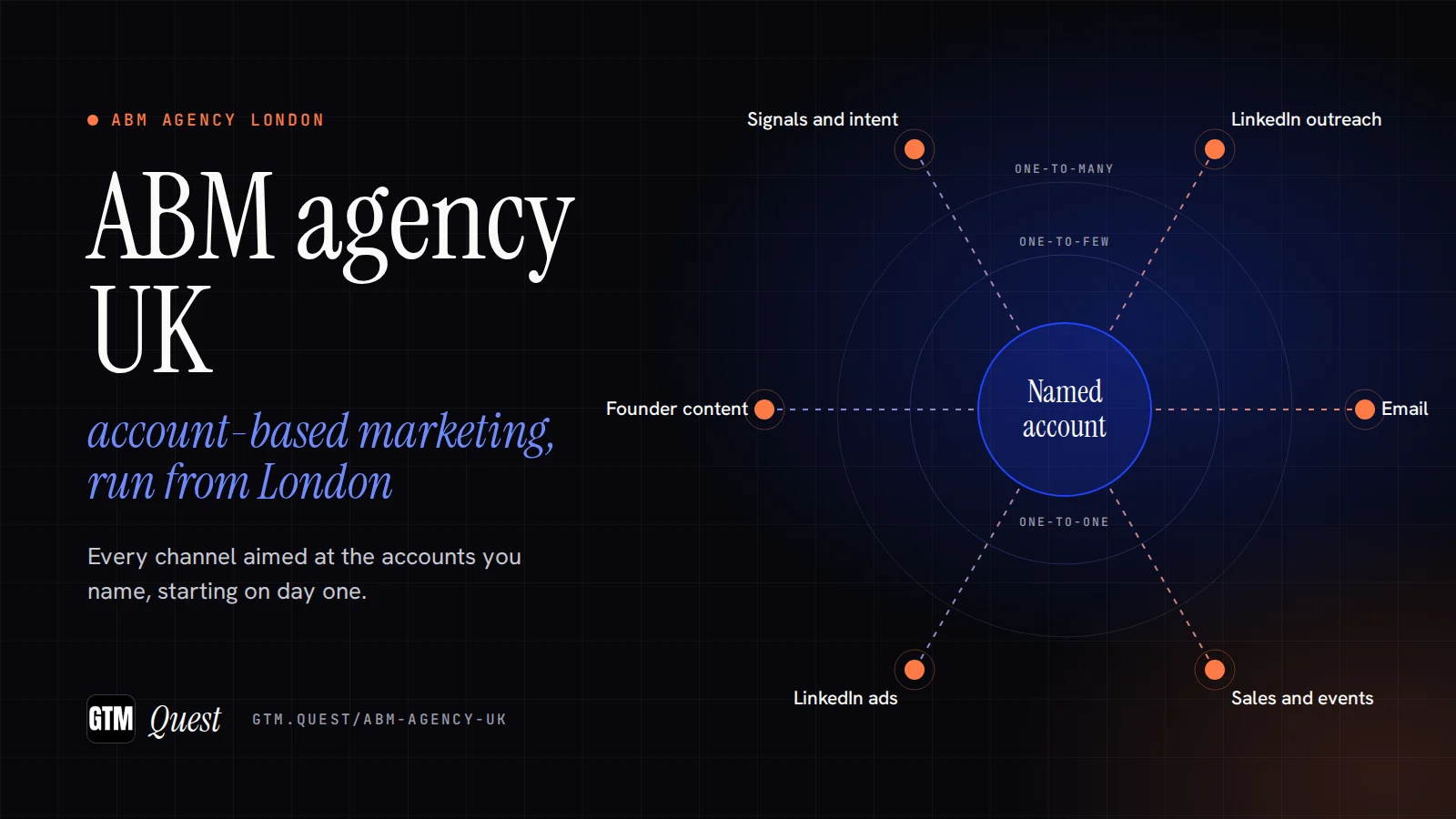
We pick the accounts worth winning with your sales team, map the buying committee in each one, and aim LinkedIn ads, founder-led content, buying signals and outreach at those accounts until they are in conversation with you.
The motion starts on day one with the accounts sales already cares about, and we build the programme around it.
The account list, the data and the playbooks stay yours.
We run it with you, or build it and hand it over.
Reviewed by Dan Keegan, GTM Quest · 29 September 2026 · 70 sources linked below
Module 01 / 03
Module 02 / 03
Module 03 / 03
01/ our service
An ABM agency builds and runs marketing aimed at a named list of accounts, with sales, measured by account.
These are the seven parts we build, and every one of them stays with you.
01
We score accounts on fit (industry, size, technology, triggers) and agree the list with your sales team.
If sales would not call an account, it does not go in.
Then we tier them: a handful one-to-one, clusters one-to-few, the rest one-to-many.
02
For every top-tier account we name the roles and, where we can, the people: the economic buyer, the champion, the users, finance, procurement and IT.
For the rest we map roles by segment.
Then we find the gaps: who in the committee has never heard from you?
03
Annual reports, filings, hiring, leadership changes, news, technology and the account's own public statements, turned into a short account plan.
It says what the account is trying to do this year and where you fit.
04
One message per cluster problem, and account-specific angles for the top tier.
Written against the objections those buyers actually raise, and built so the champion can make your case internally.
05
LinkedIn company and contact targeting, founder and team content, signal-triggered LinkedIn and email outreach, events and direct mail where they fit.
Every channel aims at the same accounts, so each one warms the next.
06
A Postgres campaign database above your CRM, enriched in Clay, holding every account, contact, signal and touch.
It is yours, not a platform vendor's, and it outlives the engagement.
07
Accounts engaged, people engaged per account, meetings, opportunities and deal speed in the target list, reviewed weekly with sales.
We promote accounts that move and demote those that don't.
ABM is how we run go-to-market for most of our clients, because a B2B go-to-market plan usually is a list of accounts.
GTM and ABM are close: read more about what a go-to-market agency does, or see how we run the whole system as a GTM agency.
02/ the discipline
ITSMA coined the term "account-based marketing" in 2003.
Bev Burgess, who led that work, told B2B Marketing she defined ABM as treating individual accounts as markets in their own right and has never changed the definition.
That is still the cleanest test of whether something is ABM.
Is the account, not the lead, the unit you plan, spend and measure against?
The first empirical academic study of the practice, published in Industrial Marketing Management in 2026 after interviews with ABM leaders in 22 firms, describes ABM as an approach that identifies high-value account opportunities, develops deep account intelligence and delivers highly personalised engagement across the sales cycle, in close collaboration with sales.
We agree with every word, and that is the job an account based marketing agency is hired to do.
An ABM agency does four things.
It selects and tiers the target accounts with you.
It maps who sits on each buying committee.
It builds the content and plays for each tier.
And it runs them across the channels your buyers use, then measures how accounts move rather than counting clicks.
Unlike a demand generation agency, the goal is depth of engagement in a named list, not the volume of leads.
Unlike a lead generation agency, the unit is the committee, not the single meeting.
Many programmes run all three: demand generation to build awareness across the market, ABM to concentrate effort on the accounts that matter most, and outbound to open doors inside them.
We set out the trade-off in account-based marketing vs demand generation.
You will see several labels.
ABM is the strategy of focusing on named accounts.
ABX, account-based experience, extends it across the whole buying group and customer journey; tmp sells ABX and Transmission sells ABX and deal-based programmes.
Account-based engagement is the same idea with sales and service written in.
BCG notes the term was first proposed by Forrester in June 2018, and argues that "account-based marketing" is a misnomer because the work only succeeds when marketing, sales and service move together.
Deal-based marketing narrows ABM to the live opportunities already in your pipeline.
B2B buying has become a committee sport played mostly without you.
Forrester puts a typical buying decision at 13 internal stakeholders and nine external influencers, and its earlier study found 89% of purchases involve two or more departments.
A form fill from one of them tells you little about where the account stands.
Those buyers do the work on their own.
Gartner's March 2026 survey of 646 buyers found 67% prefer a rep-free experience and 45% used AI during a recent purchase.
Earlier Gartner research found buyers spend 17% of their buying time meeting potential suppliers, shared across every supplier they consider.
And they decide early.
6sense found 94% of buying groups ranked their preferred vendors before first contact.
McKinsey found B2B customers now use an average of ten interaction channels, up from five in 2016.
Generic outreach does not survive that.
Gartner found 73% of B2B buyers actively avoid suppliers who send irrelevant outreach.
ABM's answer is to be known, useful and relevant to the whole committee in the accounts you chose, before any of them is ready to talk.
A LinkedIn campaign aimed at a list of company names is account-based targeting, not ABM.
Without account selection your sales team agrees with, content built for those accounts and measurement at the account level, it is expensive advertising to a spreadsheet.
03/ how it works
Four channels your target accounts can see, and a data layer they can't.
Each one warms the next: your LinkedIn ad puts an idea in front of the committee, your content breaks it down, the signals show who is paying attention, and your outreach ties it together for that account.
Document and thought-leader ads to your target account list and the roles inside it.
The committee recognises your name before anyone is contacted.
Posts, frameworks and insights from the founder and team, planned around the problems your target accounts are dealing with this year.
Outreach then arrives from a name the committee already knows.
Post engagement, website visits, hiring, funding and topic research, tracked at company level.
We know which accounts are moving, which people are paying attention, and when to press.
LinkedIn and email to the named people in each account, referencing what the account has engaged with.
Sent from your team's own profiles and protected domains, and handed to sales with the context.
A Postgres campaign database above your CRM, enriched in Clay, holding the account list, the committee maps, every signal and every touch.
A language model does research and first drafts; a person checks every message.
This is our own operational set-up, described so you can judge it; it is not an industry benchmark.
Enrichment and data operations run in Clay, which describes itself as infrastructure to get data, run agentic workflows and launch GTM plays.
The person who builds this layer is a GTM engineer, and we explain the role on GTM engineer.
If your CRM and routing need work before ABM can run on them, that is sales operations work, and we do it as part of the build.
04/ orchestration
This is an illustrative example, not a client: one target account in a one-to-few cluster, and what each channel does to it over a quarter.
The point is that nothing runs on its own schedule.
Every lane is aimed at the same committee, and each one waits for the last to do its work.
Quiet this week
The founder posts the first of four pieces on the cluster's problem.
Tracking goes live at company level.
A connection request from the founder to the one person already known.
Quiet this week
Sales agrees the account and names what they already know.
Quiet this week
The account goes into the cluster's company list, with roles layered on top.
A framework post the committee can reuse internally.
Two people from the account engage with the founder's post.
A note to the two who engaged, about the post they read.
Quiet this week
A short account plan is shared.
Quiet this week
A document ad on the cluster's shared problem reaches operations and finance.
A comment thread with an industry voice the account follows.
A company-level visit to the pricing page.
Quiet this week
Sending domains finish warming.
The weekly account review starts.
Quiet this week
A thought-leader ad from the founder follows it to the same roles.
Quiet this week
A new head of operations is announced.
A welcome to the new head of operations, with something useful for their first month.
A first email to finance, referencing the problem the ads covered.
Sales decides whether the new hire is the way in.
An invitation to a roundtable where the account's peers will be.
A case-style ad for the people who engaged with the first two.
A short piece answering the objection finance tends to raise.
Research on the category rises for the account.
A short ask for a conversation, with context.
A follow-up with the account-specific angle.
First meeting held with context on every signal.
Quiet this week
Spend narrows to the accounts whose signals moved.
Content is shaped by what the account engaged with.
Signals reviewed weekly with sales.
Follow-ups to the rest of the committee.
Mop-up for people who never saw LinkedIn.
The buying committee map fills in from the meeting.
A useful printed piece to the champion, if the account warrants it.
Ads now support a live conversation rather than start one.
A recap the champion can forward to colleagues.
The account is re-tiered on what it did, not what we hoped.
Kept warm while sales runs the deal.
Quiet this week
An opportunity is opened and marketing supports the deal.
A dinner seat at the next industry event.
Read it down a column, not along a row.
In any week, most of the lanes are doing something for the same account, and the quiet cells are deliberate: nobody gets an email before the domain is ready, and nobody gets a dinner invitation before they know who you are.
This is also why ABM needs one data layer.
The signal in week two only changes the outreach in week three if both lanes read the same account record.
05/ three tiers
ITSMA and Demandbase set out three established approaches to ABM: one-to-one, one-to-few and one-to-many.
ITSMA's Dave Munn has called them Strategic ABM, ABM Lite and Programmatic ABM.
A note on names. Many agencies call one-to-many "ABM Light".
In ITSMA's own terms ABM Lite is the one-to-few tier.
Ask any agency which tier it means before comparing proposals.
Most programmes now mix tiers.
In 2017 ITSMA found 35% of ABM practitioners used more than one approach.
By Momentum ITSMA's 2023 benchmark, 45% used two types and 30% used all three, and the median programme covered 250 accounts, although the average was over 1,000.
We usually start with one tier and earn the next.
For most UK B2B teams that means a one-to-few programme built from the accounts sales already wants, with a one-to-many layer on LinkedIn around it.
06/ size the programme
Move the sliders to your number of target accounts and the people you expect in each buying group.
The calculator shows how many people the programme has to reach, whether LinkedIn will run the lists, and which tier that size usually suits.
Gartner puts the median B2B buying group at six to 10 decision makers. Gartner ↗
LinkedIn's list minimums are 300 companies (it recommends 1,000 or more) and 300 matched members. LinkedIn Help ↗
People to reach
800
100 accounts with 8 people each, before match loss.
How we usually tier it
One-to-few
Cluster the accounts by industry or shared problem and write for each cluster.
How to read it. The people figure is simple arithmetic before match loss: not everyone on a list is found on LinkedIn.
Gartner puts the median B2B buying group at six to 10 decision makers, and its buying report puts the average enterprise group at five to 11 stakeholders from about five functions.
LinkedIn's rules decide what can run as an ad audience.
A company list needs at least 300 rows, takes up to 300,000 companies, and LinkedIn recommends 1,000 or more; a list not used within 90 days expires.
A contact list also needs at least 300 rows and 300 matched member accounts, and LinkedIn recommends uploading at least 10,000 email addresses to reach that.
So a one-to-one tier of 20 accounts cannot run as its own LinkedIn company list.
We run small tiers through contact targeting where the numbers allow, founder and team content, direct outreach and events, and put the ads budget on the cluster or programmatic layer.
The tier suggestion is how we usually split a programme, not a rule.
07/ account progression
ABM is measured by accounts moving, not leads arriving.
These are the stages we track for every account, the signal that shows it has moved, and the play that moves it on.
The signal
Sales has agreed the account fits and would take the meeting.
It has a tier and an owner.
The play
Map the committee, write the short account plan and add the account to the right LinkedIn list and cluster.
Owner: GTM Quest with your sales lead
The signal
Ad impressions reach several roles in the account.
Someone views the founder's profile or follows the company page.
The play
Keep the content useful and regular.
Start the first connection requests from the founder and the account owner.
Owner: GTM Quest
The signal
Two or more people engage with posts or ads, a company-level visit reaches a high-intent page, or research on your topic rises for the account.
The play
Personal outreach to the people who engaged, about what they engaged with.
Move the account up the weekly review.
Owner: GTM Quest, reviewed with sales
The signal
A meeting with someone on the committee, booked with the context of every signal behind it.
The play
Sales runs the meeting.
We fill in the committee map from what was learned and reach the people not yet in the room.
Owner: Your sales team, supported by us
The signal
An opportunity opened in your CRM, with a value and a stage.
The play
Deal-based support: content for the objections finance and IT raise, ads that keep the committee warm, and nothing that competes with the rep.
Owner: Your sales team
The signal
A closed deal, then usage, new teams and new sites inside the account.
The play
The account moves to a one-to-one expansion plan.
The same committee map now shows where the next team is.
Owner: Account management, with us if you want
Every account sits in exactly one stage, and the weekly review with sales looks at movement, not at activity.
An account stuck at "Aware" for a quarter is a question about fit or message, not a reason to send more.
These stages are how we run the work; they are not a published standard.
They map closely to what the benchmark says ABM reliably moves: 85% of measured programmes saw more engagement with their selected accounts, fewer saw revenue move.
08/ engagement
From complete handover to a full account-based partnership.
Pick by how much of the ABM work you want to own.
How much of the ABM work do you want to own?
Handover · build and transfer
We select and tier the accounts with you, map the committees, build the plays, the data layer and the LinkedIn audiences, then hand it to your team with training and documentation.
Best for teams with a marketer or ops person ready to own ABM.
Handover + support
Everything in Handover, then a consultant stays on one or two days a week to run the account review with sales, re-tier and troubleshoot.
Best for teams building their own ABM capability.
Embedded · run and optimise
We operate the programme as an embedded team member: the ads, the content calendar, the signals, the outreach and the weekly account review.
Your sales team runs the meetings and the deals.
Best for teams without the ops bandwidth to run ABM.
Scale · full partnership
One-to-one, one-to-few and one-to-many running together, alongside demand generation and outbound, with a dedicated team and more capacity.
Best for teams ready to make ABM how they go to market.
What it costs. Every engagement is scoped and quoted in writing after the discovery call.
Fees, media spend, data and platform licences are separate lines, so you can see where the money goes.
No long lock-in: the contract says how either side can stop.
09/ our work
client
"Working with the Quest team transformed how we approach outbound.
They built our entire Clay-based pipeline system in under four weeks and handed it over with proper documentation — we were running it independently within days.
The signal-triggered approach means we're reaching prospects at exactly the right moment."
Charlie Anderson, co-founder and Creative Director, 1 Up Productions
in progress
A Clay-powered outbound system for a UK sustainability-compliance platform: four-channel ABM aimed at companies with SECR reporting obligations, with signal-triggered outreach.
Engagement in progress; results to follow when there are results to show.
published
We publish the go-to-market playbooks, frameworks and guides we use, so you can judge how we think before you talk to us.
See GTM playbooks and the article library.
Browse the GTM strategy playbooks and all our guides.
10/ the difference
→ An ABM agency aims every channel at the accounts sales wants and is measured on those accounts. A marketing agency is measured on the audience it reached.
→ We do both, and will tell you which one you need. For strategy-only help, see GTM consultants.
→ Most teams use both, in order: prove ABM with us, then hire into it. strategicabm, for example, also sells delivered, co-delivered and training models.
→ Most B2B teams need both. See our B2B demand generation agency page.
Why it matters: in a Gartner survey of 412 senior marketing and sales leaders, the two functions collaborated on only three of 15 commercial activities.
ABM only works on the other twelve.
BCG found the same thing from the other side: in its study of account-based programmes, more than half failed at first, and the overwhelming reason was a lack of sales support and alignment with marketing.
11/ account insight
ABM research is the difference between a personalised programme and a mail merge.
The Industrial Marketing Management study names developing deep account intelligence as one of the three core activities of ABM, and it is the one most often skipped.
For a top-tier account we write a short account plan, usually two pages.
It covers what the account is trying to achieve this year, what is changing inside it, who is on the committee, what they have said in public, where you already have relationships, and the one problem you can help with first.
The inputs are mostly public.
UK companies file accounts, officers and filing history with Companies House, and listed companies publish annual reports and results.
Job postings show what a team is building.
Leadership changes, funding, acquisitions and new sites show what is moving.
Then there is what only you know.
Sales notes, past deals, support tickets and the people your team already knows inside the account.
We put the two together in the account database, so the plan and the signals live in the same record.
One-to-one: a full account plan, the committee named person by person, and a view of the account's strategy in its own words.
We refresh it monthly.
One-to-few: a cluster brief.
The shared problem, the shared language, three or four account examples and the roles that decide.
One-to-many: firmographic and technographic scoring, plus signals, handled in the data layer rather than by hand.
A language model is good at reading an annual report, a set of job postings and a year of press releases and summarising what changed.
It is not good at knowing which of those things matters to your deal.
So we use AI for the first draft of every account brief and every first line, and a person who knows your market checks each one before it is used.
Nothing reaches a buyer that a person has not read.
12/ ABM media
Account-based advertising puts paid media in front of the people inside your target accounts, and nobody else.
In the UK most of it runs on LinkedIn, because LinkedIn is where job titles and employers are known.
LinkedIn's company targeting lets you upload up to 300,000 company names and match them to LinkedIn Pages, then layer roles, functions and seniority on top.
Contact targeting lets you upload up to 300,000 contacts and match them to member accounts.
The minimums shape the programme.
A company list needs at least 300 rows, and LinkedIn recommends 1,000 or more; a contact list needs at least 300 matched member accounts before an ad set can use it.
That is why the audience calculator above matters before anyone books media.
Programmatic account-based advertising runs display and video to target accounts across the open web, usually through an ABM platform.
Demandbase says it uses AI to analyse signals, accounts and buying-group activity; AdRoll ABM, formerly RollWorks, sells account-based advertising for smaller teams.
We use it when the one-to-many list is large enough to justify the licence.
Document ads that give the committee something to keep: a framework, a checklist, a short benchmark.
Thought-leader ads that put the founder's or an expert's own post in front of the target roles.
Conversation and message formats only where the account already knows you.
Spend is weighted by tier and by signal.
Accounts that are engaging get more; accounts that have been quiet for a quarter get less, and the saving goes to the ones that moved.
Teams looking for an ABM media agency in London often want the media plan without the rest.
We will run it that way if the account list and the measurement are already sound; if they are not, the media will not fix them, and we will say so on the first call.
13/ the data layer
Intent data shows when accounts and buying-group members are actively researching topics, based on the content they consume.
Bombora separates first-party intent, from your own website and paid experiences, from third-party intent, licensed from outside them.
Its Company Surge score compares an account's most recent three weeks of activity against a 12-week baseline, across more than 21,600 topics.
6sense says its platform captures buying signals and turns them into insights and alerts.
Used at account level, this is how ABM decides where to press.
A target account that starts researching your category, visits your pricing page and engages with your LinkedIn posts in the same fortnight is a different conversation from one that has done none of those things.
It matters because most accounts are not buying.
The LinkedIn B2B Institute's 95-5 rule, from its research with the Ehrenberg-Bass Institute, holds that 95% of potential buyers are out of market at any time.
ABM stays useful to all of them and concentrates sales effort on the few whose behaviour says they have moved.
Company-level website visits; engagement with the founder's and sales team's LinkedIn posts; senior hires and promotions in the buying functions; funding rounds, acquisitions and new offices; competitor follows; and third-party topic surges where the budget allows.
Each one is a reason to reach out with something specific, not a trigger for a sequence.
We build the signal layer in the same database as the account list, so a signal is always read against the account's tier and plan.
14/ UK rules
This is where UK ABM differs from the US playbook.
Two sets of rules apply: PECR for electronic marketing, and UK GDPR for any personal data about a named contact.
The practical pattern. Build the target list from firmographics.
Watch company-level signals: which companies visit your site, engage on LinkedIn or surge on your topics.
Then reach named people one by one, under legitimate interest, with something relevant to their role, and honour every objection.
A 10,000-contact cold sequence built on purchased person-level data is where UK ABM programmes get into trouble.
Account-based marketing done properly is the opposite of that: fewer people, chosen for a reason, with a record of why.
This is not legal advice; for your own programme, speak to your data protection adviser.
15/ check before you send
Pick who you are contacting and how.
The answer comes from the ICO's guidance, and it is the same check we build into every ABM programme before the first message goes out.
Who are you contacting?
How?
Allowed
PECR's electronic mail rule does not apply to corporate subscribers (companies, LLPs, Scottish partnerships). Say who you are, give an opt-out, and remember UK GDPR still applies to a named person's data.
ICO guidance ↗ · Not legal advice
If calls are part of the plan, the ICO says B2B callers need to screen against both the TPS and the CTPS registers, as well as their own do-not-call list.
We keep one do-not-contact list across every channel, so an objection on LinkedIn stops the email too.
16/ sectors
ABM suits sectors where a few accounts carry most of the value and the buying committee is wide.
Fintech, payments, regtech, healthtech, medtech and enterprise SaaS all fit that shape.
In fintech and financial services, the committee usually includes risk, compliance, information security and procurement alongside the business owner.
The content has to answer their questions early, and the marketing itself has to be right: the FCA says financial promotions on all advertising channels should be fair, clear and not misleading, and its rules are technology neutral, applying to social media too.
That affects what an ABM agency for fintech can run.
Anything that could be read as a financial promotion needs your compliance team's sign-off before it goes out, so we build approval into the content calendar rather than bolting it on.
For wider fintech go-to-market, see our guide to GTM agencies for fintech.
In B2B SaaS, the challenge is usually the opposite: a large addressable market and a product that can sell to many teams inside one account.
ABM there is often one-to-many at the top, one-to-few for the clusters with the biggest deals, and one-to-one for expansion inside existing customers.
In medtech and healthtech, buying committees include clinicians, procurement and information governance, and claims are regulated.
We cover how ABM works there in medtech ABM.
B2B SaaS, fintech and payments, data and AI, professional services, sustainability and compliance software, and technology sold to operations, finance and IT teams.
If your market is one we have not worked in, we will say so on the first call and tell you what we would need to learn.
17/ the stack
Tools change; the jobs don't.
This is our current ABM stack, chosen per client, and the ABM platforms we work alongside.
We use what you already have where it does the job.
Do you need an ABM platform? Not to start.
A one-to-few programme runs well on a clean CRM, LinkedIn company lists, a signal layer and a weekly account review with sales.
Buy a platform when the number of accounts outgrows what people can watch, and ask who pays the licence and who owns the data if you part ways.
If your marketing automation needs rebuilding before ABM can run on it, that is a separate job; see marketing automation agencies.
18/ the honest numbers
You will have seen "87% of marketers say ABM outperforms other investments" and "208% higher marketing ROI".
The 87% is real but dated: in a 2017 ITSMA and ABM Leadership Alliance survey of companies already using ABM, 87% said it delivered higher ROI than other types of marketing.
We could not trace the 208% to any primary source, so we don't print it.
The later benchmarks from the same research team are published in full, and they are more useful.
In 2020, 76% of respondents reported higher ROI from ABM than from other marketing; in 2021 the figure was 72%.
ABM took 28% of the marketing budget in 2022 and 30% in 2023, when 66% planned to spend more on it in 2024.
The 2023 study is also candid about the limits.
Among programmes that measure results, 85% saw more engagement with their selected accounts, 78% pipeline growth and 74% revenue growth.
But only small minorities saw significant improvement above 10%: 21% for revenue and 27% for pipeline.
And only 52% of programmes measure ABM ROI at all.
BCG's study of account-based programmes, based on interviews with 34 senior executives at 21 companies, found that more than half failed at first.
But 67% of the strategic programmes and 75% of the scaled ones went on to succeed once the companies regrouped, mostly by getting sales properly involved.
Our reading: ABM reliably improves engagement with the accounts you pick.
Whether it moves revenue depends on picking the right accounts and on sales following through.
Those are the two things to test any ABM agency on, including us.
19/ timing
This is how we run one.
The motion starts on day one with the accounts sales already cares about; the programme is built around it, and each channel joins when it is ready.
Agree the first top-tier accounts with sales and start the conversations the same day: founder and team LinkedIn, warm introductions and the contacts you already have inside them. The first content goes out.
DAY 1Score accounts on fit (firmographics, technology, triggers) and agree the list with sales. If sales wouldn't call an account, it doesn't go in.
WEEK 1A handful in one-to-one, clusters in one-to-few, the rest in one-to-many. Resist putting every account in the top tier.
WEEK 1For top-tier accounts, name the roles and people. For the rest, map roles by segment. Find the gaps: who in the committee have we never spoken to?
WEEKS 1 TO 2One message per cluster problem; account plans for the top tier. Content that helps the committee make its case internally.
WEEKS 1 TO 3Website and LinkedIn signals, intent where it helps, LinkedIn company lists, email and events, each added as it is ready. One weekly review with sales of which accounts moved.
WEEKS 2 TO 4Engagement breadth, meetings, opportunities and deal speed in target accounts. Promote accounts that move; demote those that don't.
MONTHS 2 TO 3What to expect. Day one: the first conversations with people inside the top-tier accounts.
Month one: the programme built around them.
Months two and three: accounts moving through the stages, and the first opportunities where the fit is right.
This is indicative, not a promise; revenue follows your sales cycle.
You will read that ABM pays back in six to 12 months.
We could not find a primary source for that range, so treat it as folklore.
The published benchmark shows engagement improving most often and revenue least often: 85% of measured programmes improved engagement and 74% revenue, with far fewer seeing large gains.
What to measure. Agree leading indicators before the programme starts: target accounts engaged, people engaged per account, meetings booked in target accounts, opportunities created and how fast they move.
These show within a quarter.
Then the lagging ones: pipeline value and win rate in the target list against accounts outside it, and deal size.
A committee purchase is rarely quick; Forrester found 86% of B2B purchases stall during the buying process.
Judging ABM on lead volume is how bad programmes survive, and waiting for full revenue attribution is how good ones get cancelled early.
For the strategy work that comes before a programme, see our account-based marketing strategy guide.
20/ where we work
We are an ABM agency based in London.
Most of the work is remote, run through shared dashboards, a weekly account review and your team's own LinkedIn profiles, and we come to you for the workshops where being in the room matters: account selection, tiering and the first sales session.
We work with teams across London and the South East, including Surrey, Guildford and Oxford, and across the UK.
The M25 and the Thames Valley are full of B2B technology companies with exactly the problem ABM solves: a small number of large accounts that decide the year.
Beyond the UK we work with teams across Europe, including the Nordics (see B2B marketing in the Nordics), and with UK companies selling into the US.
The compliance rules are set for the market you sell into; the UK rules above do not transfer cleanly to US or EU law.
If you are comparing UK firms more widely, our guide to UK GTM agencies covers the go-to-market side, and B2B marketing agencies in the UK covers the wider field.
For every ABM-tagged firm in our directory, see ABM agencies by specialism.
21/ what it costs
Most ABM agencies quote after a scoping call, and so do we.
These are the figures the firms on our specialists list publish themselves.
What drives the price of ABM. The number of accounts in the one-to-one and one-to-few tiers (each needs research and content), paid media (usually billed separately), the platforms you need licences for, and whether the agency runs the programme or trains your team to run it.
Ask every agency for the media budget and platform costs as separate lines.
A short, paid scoping phase with a written account list and tiering is a better start than a long retainer signed on a pitch deck.
22/ before you sign
01
Data-driven ICP scoring that sales signs off, or a list your sales team wrote from memory?
The first compounds; the second drifts.
02
Account-level engagement, progression and pipeline, or last-click lead metrics?
ABM measured on MQLs will be judged a failure.
03
A good ABM agency resists putting every account in the one-to-one tier and can say what it would drop.
04
You should, in writing: the account list, the contact data, the audiences, the dashboards and the platform accounts.
05
Where contacts come from, the lawful basis, the legitimate interests assessment and how objections are handled across channels.
06
Named people in the proposal, and the proportion of senior time.
Ask to meet the account lead, not only the pitch team.
07
Expect a weekly account review and shared account plans.
An agency that asks nothing of sales is running advertising.
23/ walk away
Quoting a number nobody can trace to a primary source is a sign of how the agency will report to you.
Lead counts reward the wrong behaviour in an account-based programme.
One-to-one means a plan per account.
Nobody writes 2,000 of them.
Under UK GDPR and PECR, this is a risk you carry, not the agency.
ABM without sales is display advertising with a target list.
The account list and tiers come first; the tool follows.
24/ niche specialists
We run ABM inside a whole go-to-market system.
Some teams need a firm built around one narrower thing: enterprise one-to-one programmes, tech-sector ABX, creative-led campaigns, programmatic ABM on a platform they already own, or a region we don't cover.
These are examples of ABM agencies with that kind of specialism, in no order.
Each line is what the firm says on its own site.
Best for: B2B technology companies that want an ABM-only specialist, including teams that want to be trained to run ABM themselves
Publishes: ABM programmes from $20,000 a month (shown as £16,500); ABM Readiness Workshop $10,000 (£8,000). Source ↗
Best for: Large technology, telco and professional-services brands running multi-tier enterprise programmes
Best for: Enterprise technology brands that want ABM inside one agency covering strategy, creative and demand
Best for: Established B2B brands that want deal-based marketing tied closely to sales, on 6sense
Best for: B2B challengers who want ABM that leads with creative
Best for: Electronics, IT and industrial-technology firms where analyst and media credibility matter as much as pipeline
Best for: International manufacturing, technology and professional-services brands wanting creative ABM with advocacy
Best for: SaaS, AI and tech companies of roughly £2M to £20M ARR wanting ABM blended with demand generation under one retainer
Publishes: From £3,500 a month plus project fees; tiers from £7,500 and £15,000 a month. "A typical investment is £5K–£15K per month"; media spend separate. Source ↗
Best for: Technology, built-environment, financial-services and manufacturing brands wanting ABM with PR and brand
Best for: Teams selling into Australia and Asia-Pacific that run ABM on 6sense
Best for: Enterprise revenue teams in the US that already own ABM platforms and need them run as one programme
Best for: B2B SaaS and technology firms in North America whose marketing and sales hand-offs leak pipeline
How to read this list. It is not a ranking and nobody paid to appear.
Each line describes the firm in its own words, checked on its own site on 28 September 2026.
Prices appear only where a firm publishes them (see what UK ABM agencies publish on price).
Who is behind the names. The UK ABM market is consolidating, so check who you contract with.
Accenture acquired MomentumABM, the UK-headquartered consultancy that had earlier absorbed ITSMA, in September 2025.
Transmission acquired Earnest in January 2025, and The Marketing Practice became tmp in August 2025.
25/ terms
GTM Quest editorial guide · Updated 10 October 2026
Choose a UK account-based marketing agency and buying-group programme
Practical guide · 01
A named-account list is the start of ABM, not the programme. Connect the commercial problem to the people who can validate, fund and use the solution.
Record why this account fits, what changed and which problem the offer can credibly solve. A funding event alone does not prove demand.
Separate the user, budget owner and technical evaluator. Plan evidence relevant to each instead of repeating one message.
Give sales a reason to act and a named owner. Marketing engagement is context for a conversation, not permission to claim an opportunity.
Practical guide · 02
Keep definitions stable across the agency and sales team. A busy account can still have no active purchase, and a quiet account may already be in procurement.
Which relevant accounts and roles can you reach? Missing contacts and consent constraints are operational gaps.
What did the account actually do? Separate observed actions from inferred intent and anonymous traffic.
Has sales confirmed a problem, a next step and the stakeholders needed to act? Record that separately from campaign engagement.
Practical guide · 03
Fictional example: an industrial software vendor targets a manufacturer. The finance lead, plant manager and IT evaluator need different evidence.
Practical guide · 04
Different account economics require different effort.
Use bespoke research where the potential relationship supports it.
Share material only where accounts have a genuine common problem.
Practical guide · 05
An observed event is not proof of buying intent.
Record the public event and why it may matter.
Check fit and the commercial circumstance before selecting outreach.
Practical guide · 06
A buying group does not consume one uniform pitch.
Explain the workflow and implementation burden.
Explain the commercial assumptions, risk and evaluation route.
Practical guide · 07
Campaign engagement should arrive with context.
Provide the relevant interaction and the account hypothesis.
Confirm the problem and mutually agreed next action.
Practical guide · 08
The list should improve as evidence arrives.
Record the reason the account does not fit.
Reopen only when a relevant circumstance changes.
15 minutes · video or phone
Bring your account list, or the deals you most want to win. We come back with how we would tier them, which signals to watch and what we would run first, whether or not you work with us.
Pick a day that suits · live availability
26/ questions
The questions B2B teams ask before hiring an account-based marketing agency in the UK, and about how we work.
An ABM agency builds and runs account-based marketing: it selects and tiers target accounts with your sales team, maps each buying committee, researches the accounts, builds the content and plays, runs them across LinkedIn, content, outreach and events, and measures results by account.
The right one fits your deal size, sector and how much of the work you want to own.
We are an ABM agency in London that builds ABM inside the whole go-to-market system and runs it with you or hands it over.
If you need a narrower specialism, see other ABM agencies with a niche specialism.
Yes.
GTM Quest is based in London and works with teams across the UK, including Surrey, Guildford and Oxford, and across Europe.
Most of the work is remote, and we come to you for account selection and the first sales session.
See ABM agency London.
An ABM consultant diagnoses and plans: the accounts, the tiers and the strategy.
An account based marketing agency also builds and runs the programme.
We do both and will tell you which you need.
See the comparison.
For ongoing senior advice across the whole motion, not only ABM, see what a go-to-market advisor does.
The account insight behind a programme: what each target account is trying to achieve, what is changing inside it, who sits on the committee and where you can help first.
It draws on filings, annual reports, hiring, news and what your own team knows.
See ABM research.
Paid media aimed only at the people inside your target accounts, usually through LinkedIn company and contact targeting, and through ABM platforms for programmatic display.
LinkedIn company lists need at least 300 rows and LinkedIn recommends 1,000 or more (LinkedIn Help).
See ABM media.
Yes.
In fintech the buying committee usually includes risk, compliance and security, and the FCA says financial promotions should be fair, clear and not misleading on every channel, social media included.
We build compliance sign-off into the content calendar.
One-to-one gives each of a small number of strategic accounts, typically 5 to 50, its own programme.
One-to-few groups 5 to 15 similar accounts into a cluster with shared messaging.
One-to-many applies ABM to hundreds or more accounts through segments and automation (ITSMA).
See the three types.
The first conversations start on day one, and engagement with target accounts usually moves within the first quarter; revenue follows your sales cycle.
The widely quoted six-to-12-month payback has no primary source we could find.
See how long ABM takes.
Target accounts engaged, people engaged per account, meetings, opportunities and deal speed first; then pipeline value, win rate and deal size in the target list against the rest.
Not MQLs.
Only 52% of programmes measure ABM ROI at all, so agree the measures before you start.
It can be.
PECR's rule on marketing emails does not apply to corporate subscribers such as limited companies (ICO), but data protection law still applies to a named contact's personal data, and people can always object to direct marketing (ICO).
See the UK rules; this is not legal advice.
Not to start.
A one-to-few programme runs on your CRM, LinkedIn company lists, a signal layer and a weekly account review with sales.
A platform earns its cost when the account list outgrows what people can watch.
The median programme in Momentum ITSMA's 2023 benchmark covered 250 accounts.
Use the audience calculator to check your list against LinkedIn's minimums and your buying-group size.
We agree the first top-tier accounts with your sales team and start conversations the same day, from the founder's and team's LinkedIn, warm introductions and contacts you already have inside those accounts.
The data layer, signals and channels are built around that running motion over the first month.
The best published benchmark found 85% of measured programmes improved engagement with selected accounts and 74% saw revenue growth, but only 21% saw revenue growth above 10% (Momentum ITSMA, 2023).
ABM reliably improves engagement; revenue depends on account selection and sales follow-through.
See the evidence.
Ask how it selects accounts, how it attributes results, how it keeps tier discipline, who owns the data afterwards, how it meets UK GDPR and PECR, who does the work, and what it needs from your sales team.

Book 15 minutes · London · UK and Europe
A 15-minute call, a written next step, and an account-based programme built with you, then run together or handed over.
28/ sources
Each figure links to its source. Original source checks: 29 September 2026. The practical guide was updated on 10 October 2026.