
GTM meaning · definition · glossary
GTM meaning what go-to-market means, in plain English
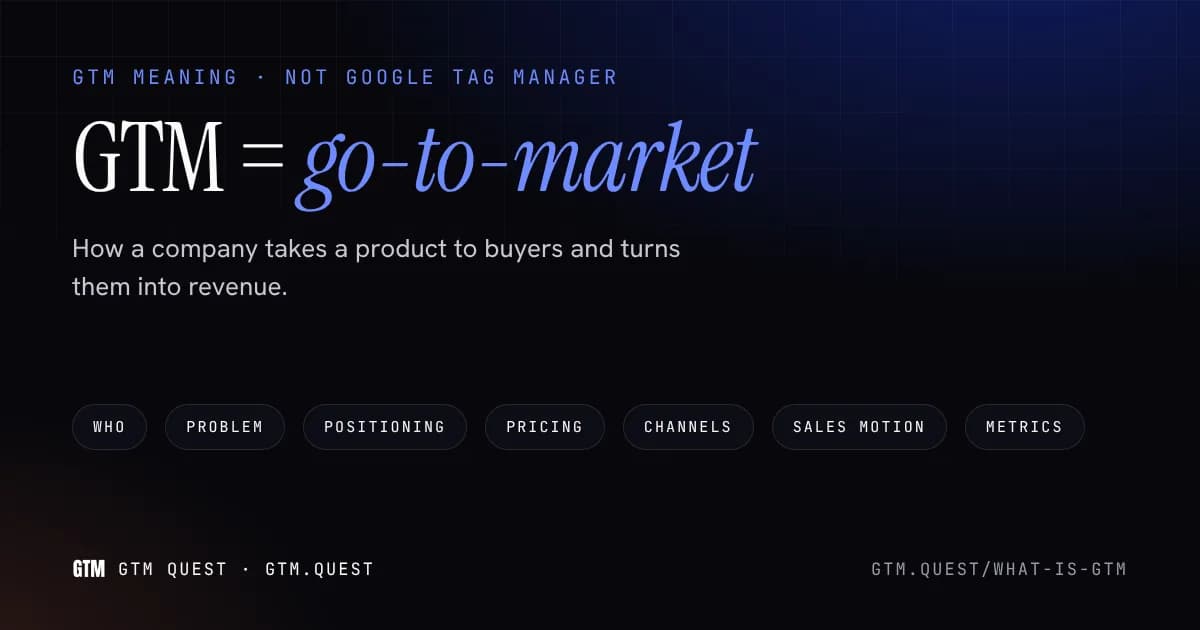
GTM stands for go-to-market: how a company takes a product to buyers and turns them into revenue. It covers who you sell to, what problem you solve for them, how you price, which channels you use, how the sale happens and how you measure it.
If you were looking for Google Tag Manager, also shortened to GTM, that is a free Google tool for managing website tracking tags; Google's Tag Manager page is here.
The rest of this page is about go-to-market: the definition, the terms built on it, what GTM means in a job title, and where the term came from.
Reviewed by Dan Keegan, GTM Quest · October 16, 2026 · 19 sources linked below
GTM in four questionswhat every go-to-market answers
- 01Who buys, and why now?WHOICP · BUYING GROUP
- 02What do we say to them?WHATPROBLEM · POSITIONING
- 03How do they find us and buy?HOWCHANNELS · MOTION · PRICE
- 04How do we know it works?PROOFPIPELINE · CAC · WIN RATE
Parts of a GTM strategy7
01/ the definition
What does GTM mean? GTM = go-to-market
GTM means go-to-market. It is the set of decisions and activities that take a product from "built" to "bought": choosing the buyers, shaping the message, setting the price, picking the channels, running the sale and measuring the result.
Gartner's definition: a GTM strategy is "a plan that details how an organization can engage with customers to convince them to buy their product or service and to gain a competitive advantage".
Harvard Business School Online calls it "a detailed plan of how your startup will reach its target customers effectively and efficiently", where effectiveness is how fast you reach and convert customers and efficiency is how profitably you do it.
In everyday speech people drop the word "strategy".
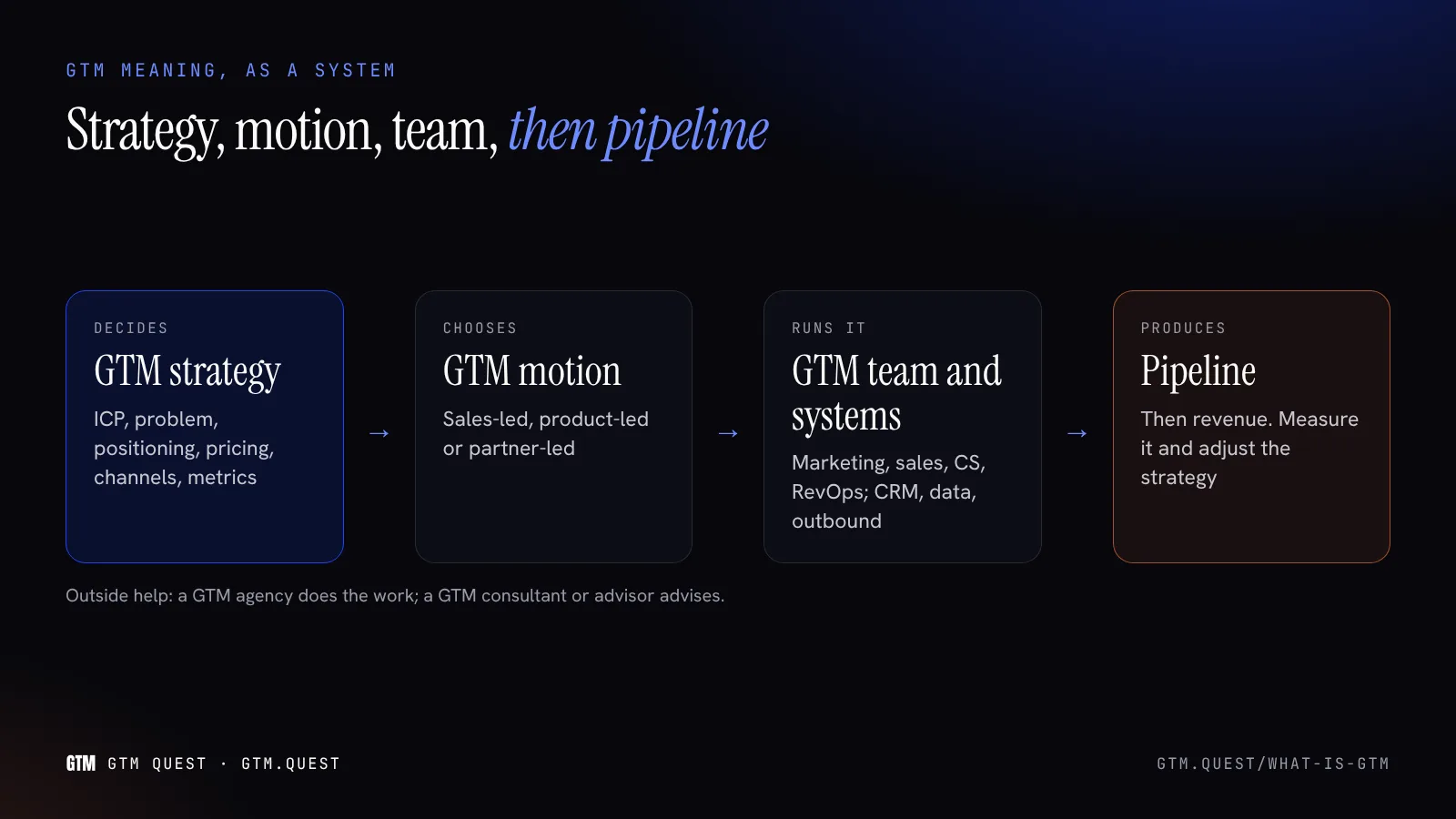
"Our GTM" usually means the whole system: the plan, the people who run it and the tools they use.
"GTM" on its own is almost always an adjective in disguise, short for go-to-market strategy, motion, team or plan.
GTM definition in one line
Go-to-market (GTM): how a company reaches the buyers it has chosen, persuades them to buy and turns that into repeatable revenue.
A quick example
For example: a company sells payroll software to UK accounting firms with 20 to 200 staff.
Its GTM is the answer to "which firms, which person in each, what we say, what it costs, how they hear about us, who closes the deal and what number tells us it is working".
Change any one of those and the GTM has changed, even if the product has not.
02/ which GTM?
GTM can mean something else go-to-market vs Google Tag Manager
Searches for "GTM meaning" mix two very different things.
Here is how to tell which one you need.
Business
Go-to-market
The plan and system for taking a product to buyers.
This is what GTM means in job titles ("head of GTM", "GTM engineer"), in sales and marketing, and in startup and investor language.
The rest of this page covers it.
If the sentence mentions buyers, pipeline or launch, it is this one.
Web analytics
Google Tag Manager
A free Google tool that lets you "manage all your website tags without editing code": the snippets for analytics, conversion tracking and ads.
Google announced its first release on October 1, 2012.
If the sentence mentions tags, triggers, containers or GA4, see Google's Tag Manager page.
Typo
GMT, not GTM
Greenwich Mean Time is GMT.
"GTM time" is almost always a typo for GMT, not a business term.
Check the letter order before you search again.
03/ in business
What is GTM in business? explained plainly
Every company that sells anything has a go-to-market, whether or not it has written one down.
Bain put it bluntly in 2012: "Every company has a go-to-market process, of course. That's why they have functions called Sales, Marketing, Product Management and so forth." The question is whether those functions work as one system or as separate fiefdoms.
Gartner lists what a GTM strategy covers: "pricing, sales and channels, the buying journey, new product or service launches, product rebranding or product introduction to a new market".
Wikipedia's article adds the outside resources a company uses to reach customers, such as a sales force and distributors.
GTM matters more than it used to because buyers have changed.
Gartner found 61% of B2B buyers prefer an overall rep-free buying experience, and Forrester's 2026 research found the typical buying decision now involves 13 internal stakeholders and nine external influencers.
A GTM built for one buyer and one salesperson no longer fits how B2B purchases happen.
GTM vs marketing vs sales
Marketing creates awareness and demand.
Sales turns demand into signed deals.
GTM is the plan above both: which market, which buyer, which message, which channel, which motion.
McKinsey describes redefining the go-to-market engine as "a cross-functional sport" that needs sales, marketing, HR, IT and finance.
Enterprise GTM meaning
Enterprise GTM means a go-to-market aimed at large organizations: long sales cycles, big buying groups, procurement and security reviews, and usually field or account-based selling.
Forrester found procurement professionals are decision-makers in 53% of business buying cycles, and that 78% of buyers making purchases of $10 million or more run a trial first.
Enterprise GTM is built around those realities.
What is the GTM process?
The GTM process is the order you make the decisions in: pick the market and buyer, prove the problem, write the positioning, set the price, choose channels and motion, launch, measure, then adjust.
HBS's Rock Center notes that the strategy is never finalized; it is iterative.
04/ glossary
GTM glossary the terms built on "go-to-market"
Each term links to the gtm.quest page that covers it in depth.
05/ GTM motion
Sales-led, product-led or partner-led? the three GTM motions
McKinsey splits go-to-market models into direct sales (key-account, field, inside sales, e-commerce) and indirect sales (partners, resellers, distributors).
In practice most B2B teams lead with one motion and support it with the others.
How do most of your deals happen today?
Sales-led
Sales-led GTM
Salespeople find, qualify and close deals.
Marketing creates demand and air cover; sales development books the meetings.
It suits higher prices, complex products and large buying groups.
- ✓ Account executives and SDRs
- ✓ Outbound and account-based plays
- ✓ Measured on pipeline, win rate and cycle length
See lead generation and ABM.
Product-led
Product-led GTM (PLG)
Users find the product, try it free or cheaply, and upgrade.
Blake Bartlett, then a partner at OpenView, coined "product-led growth" in 2016.
Built In describes it as growth that relies on a try-before-you-buy product experience, rather than conventional selling, to drive acquisition, activation and expansion.
- ✓ Free trial or freemium
- ✓ In-product onboarding and upgrade prompts
- ✓ Measured on activation, conversion and expansion
Many PLG companies add sales later for larger accounts. See SaaS marketing.
Partner-led
Partner-led GTM
Resellers, distributors, agencies, marketplaces or technology partners sell or recommend your product.
Gartner describes a sales channel as the way a B2B sales organization goes to market, "either through direct or indirect routes".
- ✓ Reseller and referral agreements
- ✓ Marketplace listings and integrations
- ✓ Measured on partner-sourced and partner-influenced pipeline
See HubSpot partner agencies for one example of a partner ecosystem.
There is no single right motion.
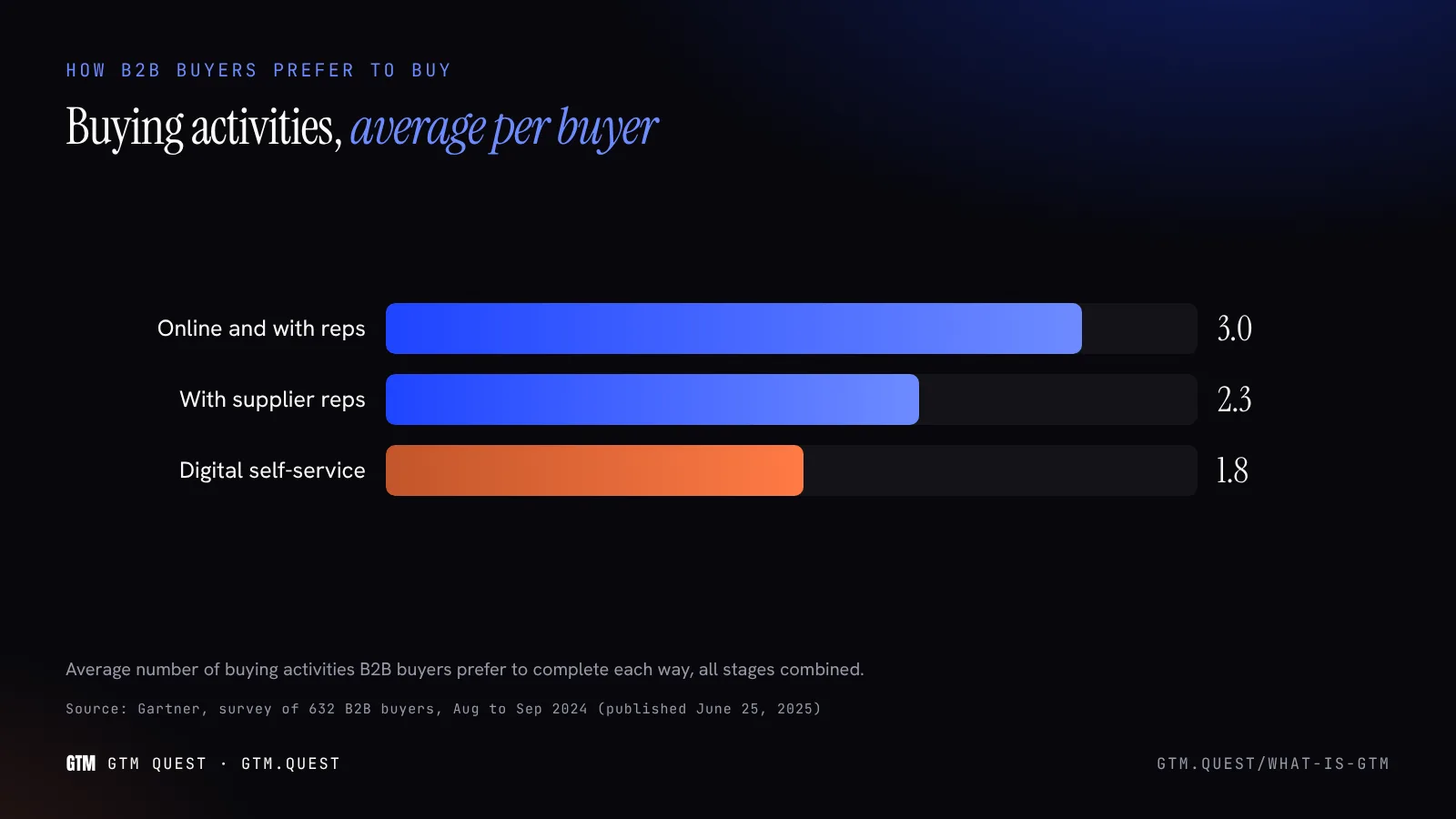
Gartner's buyer research suggests buyers want self-service for general research but seller input for judging whether a product fits their needs, which is why many teams now run a hybrid.
06/ GTM in job titles
GTM meaning in a job title why so many roles now say "GTM"
A job title with "GTM" in it means the role works on bringing in revenue across teams, not inside just one of them.
Here is what the common ones usually involve.
Why titles say GTM. Companies use it when a role spans functions, or when they do not want to commit to "marketing" or "sales" yet.
The trend is real: Bloomberry counted a 205% rise in GTM engineering and RevOps postings from January to September 2025 against the same months of 2024.
The label can also be vague.
"GTM" in a title does not tell you what the job is, and Bloomberry concluded that GTM engineering and RevOps postings are "essentially the same" in their responsibilities.
Read the duties, not the title.
Pay for these roles is in our GTM salary guide.
07/ at a glance
What does a GTM strategy include? seven parts
The short version.
Our GTM strategy guide covers each part in depth, with templates.
- 01
Who
The market and the ideal customer profile, down to the people in the buying group. HBS's Rock Center starts with ["Who is your customer?"](https://entrepreneurship.hbs.edu/Documents/Session%20Summary/HBS%20Rock-%20Go-To-Market%20Strategy%20-%20FINAL.pdf)
ICP - 02
What problem
The specific, costly problem you solve, in the buyer's words. Customers buy solutions to problems, not products.
PROBLEM - 03
Positioning
Why you, against the alternatives the buyer is really considering, including doing nothing.
MESSAGE - 04
Pricing
How you charge and what it costs to win a customer. HBS Online names [estimated customer acquisition cost](https://online.hbs.edu/blog/post/go-to-market-strategy-framework) as one of three key facets.
PRICE - 05
Channels
Where buyers learn and buy: search, LinkedIn, events, partners, marketplaces, direct outreach.
REACH - 06
Sales motion
Sales-led, product-led, partner-led or a hybrid, and who does what at each stage.
MOTION - 07
Metrics
Pipeline created, win rate, sales cycle, CAC and payback, and retention. Agreed before launch, not after.
PROOF
Ready to score your own?
The GTM readiness scorecard asks seven questions on where your go-to-market stands.
08/ history
Where did the term GTM come from? documented milestones, not legend
To "go to market" is old plain English for taking goods to sell.
We found no authoritative source for the first business use of "go-to-market", so this is a list of documented milestones, each linked to its source.
HBS Online places GTM inside the business model: in the course Launching Tech Ventures, GTM strategy is one of eight components, alongside customer value proposition, profit formula and technology and operations.
09/ misuse
Common mistakes with the term GTM and what people actually mean
01
Using GTM to mean "launch"
A launch is one event.
GTM is the ongoing system that keeps winning customers after launch day.
Gartner's definition includes launches, but also pricing, channels and the buying journey.
02
Using GTM to mean "sales"
Sales is one part.
McKinsey calls redefining the go-to-market engine "a cross-functional sport"; a sales-only plan misses product, pricing and marketing.
03
Writing a GTM with no ICP
A plan aimed at "SMBs and enterprises in every industry" is not a GTM.
HBS's Rock Center is direct: no product or service is universal.
04
Treating it as a document
The plan goes stale the day buyers change.
HBS's Rock Center says the strategy is never finalized; it is iterative.
05
Confusing the two GTMs
A request to "fix our GTM" from a web developer probably means Google Tag Manager.
From a CEO, it means go-to-market.
Ask before you scope the work.
06
Putting GTM in a title instead of a job description
If a role says "GTM" but cannot name its three most important outcomes, the title is doing the work the job description should do.
10/ our service
What is a GTM agency? and what GTM Quest does
A GTM agency designs and runs parts of a company's go-to-market.
A GTM consultant usually advises; an agency also does the work.
For the long answer, read what a go-to-market agency is.
01
ICP and positioning
Who to sell to, the problem you solve and why you, written down and agreed with sales before anything is launched.
02
LinkedIn content and ads
Founder-led content and paid LinkedIn aimed at the accounts in your ICP, so they know you before they need you.
03
Signal-led outbound
Outbound built on Clay and our own Postgres database: target accounts, buying signals, research and sequences.
See GTM engineering.
04
Account-based programs
Coordinated marketing and sales for named accounts.
If that is your main need, see our ABM agency page.
05
CRM and RevOps
A clean CRM, routing and reporting in HubSpot or Salesforce, so the GTM you planned is the GTM you can measure.
GTM Quest is a GTM agency in London working with UK and US B2B teams.
We run the work with you, or build it and hand it to your team.
Every engagement is scoped and quoted in writing after a first call.
For a part-time leader instead of an agency, see fractional GTM on our sister site.
15 minutes · video or phone
Book 15 minutes on your go-to-market
Tell us who you sell to and how deals happen today. We come back with the one or two GTM decisions we would make first, whether or not you work with us.
- 0115 minutes, video or phone
- 02We look at your ICP, positioning and pipeline
- 03A written next step after the call
- 04Run with you, or built and handed over
Pick a day that suits · live availability
11/ questions
GTM meaning FAQ
The questions people search about what GTM means, answered in a sentence or three, with sources.
GTM stands for go-to-market: how a company takes a product to buyers and turns them into revenue.
See what GTM means.
Go-to-market: the plan and system for reaching chosen buyers and selling to them.
Gartner defines a GTM strategy as a plan for how an organization can engage with customers to convince them to buy.
Sometimes.
In web analytics GTM means Google Tag Manager, a free tool for managing website tags; Google's page is here.
In business, sales and job titles, it means go-to-market.
The written plan behind your go-to-market: buyer, problem, positioning, pricing, channels, motion and metrics.
Our GTM strategy guide goes through each.
Seven parts: who, what problem, positioning, pricing, channels, sales motion and metrics.
The order you make GTM decisions in: buyer, problem, positioning, price, channels and motion, then launch, measure and adjust.
HBS's Rock Center notes the strategy is never finalized.
An outside firm that designs and runs parts of your go-to-market, such as positioning, content, ads, outbound and RevOps.
A GTM consultant advises on strategy, usually on a project basis; a GTM advisor is typically an experienced operator advising on an ongoing, part-time basis.
Compare options on our GTM consultant page, which also covers what a go-to-market consultant charges.
Recruiting for go-to-market roles: sales, marketing, RevOps and GTM engineering.
See GTM recruiters.
It signals a revenue role that spans teams.
A GTM manager runs launches and programs; a GTM engineer builds the systems the team uses.
See GTM in job titles.
Usually someone who plans and coordinates go-to-market programs and launches across sales and marketing, then tracks results.
Duties vary a lot, so read the job description.
Open roles are on GTM jobs.
A go-to-market built for large organizations: big buying groups, procurement and long cycles.
Forrester found procurement is a decision-maker in 53% of business buying cycles.
See enterprise GTM.

Book 15 minutes · London · UK and US
Now you know what GTM means. Let’s look at yours.
A 15-minute call on who you sell to and how deals happen today, and a written next step, whether or not you work with us.
13/ sources
Every source on this page
Each figure above links to one of these. All were opened and checked on October 16, 2026.
- Gartner, 61% of B2B buyers prefer a rep-free buying experience (June 2025)gartner.com
- Forrester, The State of Business Buying, 2026 (press release, Jan 2026)forrester.com
- Bloomberry, I analyzed 1,000 GTM engineering jobs (Oct 2025, updated Jan 2026)bloomberry.com
- Gartner Sales Glossary, Go-to-Market (GTM) Strategygartner.com
- Harvard Business School Online, How to Develop a Go-to-Market Strategy for Your Tech Venture (July 2023)online.hbs.edu
- Google Marketing Platform, Google Tag Managermarketingplatform.google.com
- Google Analytics Blog, Introducing Google Tag Manager (Oct 2012)analytics.googleblog.com
- Bain & Company, Creating an adaptive go-to-market system (Jan 2012)bain.com
- Wikipedia, Go-to-market strategyen.wikipedia.org
- McKinsey, What the future science of B2B sales growth looks like (Jan 2018)mckinsey.com
- HBS Rock Center for Entrepreneurship, Go-To-Market Strategy (session summary, PDF)entrepreneurship.hbs.edu
- Gartner Digital Markets, How to Establish an Account-Based Marketing Strategy (Mar 2021)gartner.com
- McKinsey, Accelerating revenue growth through tech-enabled commercial excellence (Dec 2019)mckinsey.com
- AppDirect, Decoding Product-Led Growth: Blake Bartlett on Trailblazing the Path to PLGappdirect.com
- Built In, Product-Led Growthbuiltinboston.com
- Gartner Sales Glossary, Sales Channelgartner.com
- Clay, The complete guide to GTM engineering (June 2026)clay.com
- Fractional Quest, Fractional GTMfractional.quest
- Lawrence G. Friedman, Go To Market Strategy (2002), Routledge listingroutledge.com