
GTM strategy · framework · template · London
Go-to-market strategy the decisions, the framework and a template
A go-to-market strategy is the written set of choices about who you sell to, what problem you solve for them, how you price it, how buyers find you and how a deal gets done.
GTM strategy is the same thing, shortened.
It is a short list of decisions, each backed by evidence, not a slide deck.
This guide covers the seven decisions every GTM strategy has to make, a step-by-step framework, a template you can fill in, documented examples, how to choose a sales motion, and the benchmarks to measure it against.
GTM Quest builds and runs go-to-market strategy for B2B teams from London; if you want help with yours, book 15 minutes.
Reviewed by Dan Keegan, GTM Quest · October 16, 2026 · 19 sources linked below
How we build a GTM strategy with youfour sprints, written down
- 01Evidence: buyers, deals, dataWEEKS 1 TO 2INTERVIEWS · CRM
- 02Decisions: ICP, positioning, priceWEEKS 2 TO 4ONE-PAGE STRATEGY
- 03Motion and channels, testedWEEKS 4 TO 8SMALL BATCHES
- 04Measure, then scale or hand overWEEKLYPIPELINE · CAC · WIN RATE
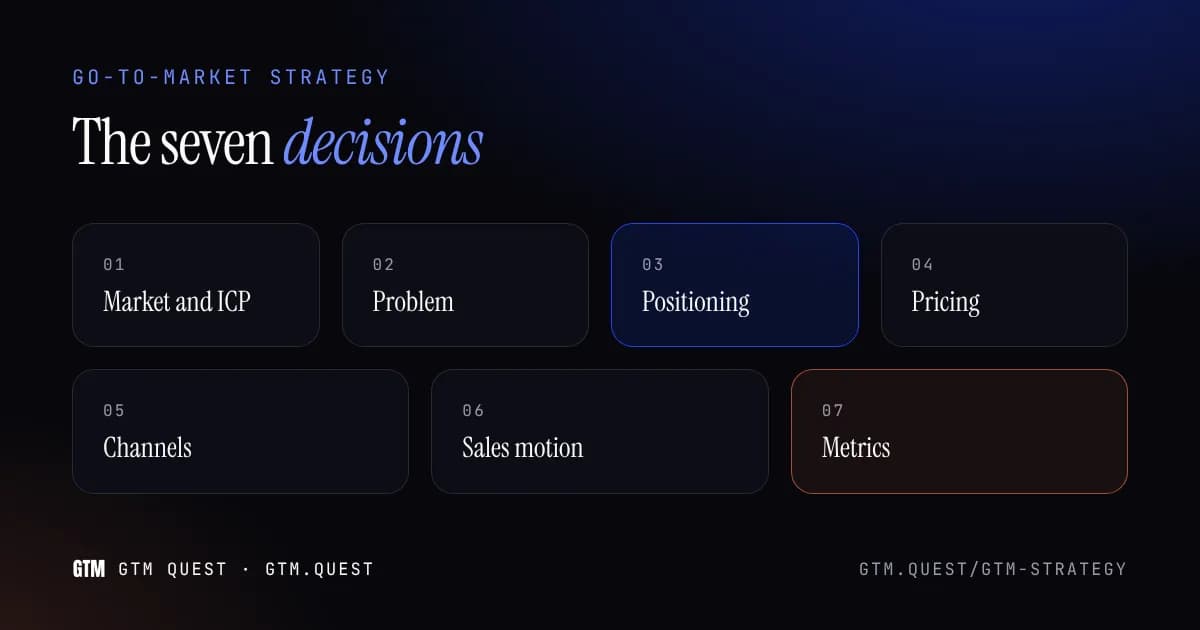
Decisions in a GTM strategy7
01/ the definition
What is a GTM strategy? and what it is not
Harvard Business School Online defines a go-to-market strategy as "a detailed plan of how your startup will reach its target customers effectively and efficiently", where effectiveness is how quickly you reach and convert customers and efficiency is how profitable that effort is.
In the HBS business model framework taught by Jeffrey Bussgang, GTM strategy is one of eight components, sitting between the customer value proposition and the profit formula.
In practice, a GTM strategy answers seven questions: which market and which customers, what problem and why you, what price and package, which channels, which sales motion, how the team is enabled, and which numbers prove it works.
Each answer constrains the next.
A low price rules out field sales; a narrow ICP makes account-based marketing affordable.
It is not a launch plan, a marketing plan or a sales target.
Those come after the strategy and depend on it.
High Alpha's 2025 SaaS benchmarks report found that go-to-market execution still tops the list of challenges that keep founders up at night, and in our experience execution usually fails because a decision upstream was never made.
GTM strategy meaning
GTM stands for go-to-market: the work of taking a product to buyers and turning them into customers.
A GTM strategy is the set of choices behind that work.
"GTM strategies" in the plural usually means the different motions a company can use, such as sales-led, product-led or partner-led, covered below.
GTM strategy vs go-to-market plan
The strategy is the choices; the go-to-market plan is the schedule that executes them: owners, budgets, campaigns and dates, usually for 90 days at a time.
Write the strategy once and revisit it each quarter.
Rewrite the plan every quarter.
It is also narrower than a business plan.
Stripe's guide describes a GTM strategy as more narrow than a business plan, focused on launching a single product or entering one new market.
A company with three products or two markets may need more than one.
GTM marketing and sales GTM strategy
GTM marketing is the marketing part of the plan: positioning, messaging, content, paid and events aimed at the ICP.
A sales GTM strategy is the sales part: segments, territories, the sales motion, qualification and the handoffs between SDRs, account executives and customer success.
Both should come from one strategy, or buyers notice.
Gartner found 69% of B2B buyers report inconsistencies between a supplier's website and what its sellers say.
02/ the context
Why GTM strategy is harder in 2026 how B2B buyers buy now
Buying groups are bigger.
Forrester's State of Business Buying 2026 found the typical decision now involves 13 internal stakeholders and nine external influencers, procurement is a decision-maker in 53% of buying cycles, and more than 60% of buyers use a trial before they buy.
Buyers would rather not talk to you early.
Gartner's March 2026 survey found 67% of B2B buyers prefer a rep-free experience and 45% used AI during a recent purchase.
Its 2025 survey found 73% actively avoid suppliers who send irrelevant outreach.
But reps still matter at the right moment: Gartner reports buyers are 1.8 times more likely to complete a high-quality deal when they use supplier digital tools alongside a rep rather than alone.
The channels have multiplied.
McKinsey's 2026 B2B Pulse survey of nearly 4,000 decision-makers found buyers use an average of ten channels across the buying journey, and that market leaders are four times more likely to deploy true one-to-one personalization.
Most of your market is also not buying today: LinkedIn's B2B Institute and the Ehrenberg-Bass Institute put it as the 95-5 rule, where 95% of potential buyers are not in market at any given time.
03/ what it includes
What does a GTM strategy include? the seven decisions
Make them in this order.
Each card gives the question, what a good answer looks like, and the evidence to collect.
01
Market and ICP
Which market, which segment first, and which accounts and people inside it.
Size the market as TAM (total demand), SAM (the part you can serve) and SOM (what you can realistically win soon), then write the ideal customer profile your team will actually use.
Ebsta found getting the right sellers to the right customers boosts quota attainment by 90%.
02
Problem and positioning
What the buyer would do if you did not exist, what you have that those alternatives do not, and why that matters to them.
April Dunford's method starts with competitive alternatives, then differentiated capabilities, value, best-fit customers and market category, in that order.
Positioning first, messaging second.
03
Pricing and packaging
The price metric (per seat, per usage, per location, flat), the tiers, and what is free.
Price sets the motion: a few hundred dollars a year cannot carry a field sales team; a six-figure contract cannot close by credit card.
Forrester found 78% of buyers spending $10 million or more trial first.
Package for the trial.
04
Channels
How buyers will hear of you and find you: inbound (content, SEO, community, product virality), outbound (email, LinkedIn, calls), paid, events and partners.
Pick two or three to do well.
Ebsta's 2025 benchmarks found partner referrals the most efficient pipeline source for new business.
05
Sales motion
Who or what closes the deal: the product (product-led), a sales team (sales-led), partners (partner-led) or a coordinated team on named accounts (account-based).
Most companies run one motion per segment.
See the motion picker.
06
Enablement
What the team needs to execute: the playbook, discovery questions, qualification criteria, battle cards, demo flow, proof (case studies, ROI) and the CRM fields that track it all.
Ebsta reports well-qualified deals win far more often; top performers are 24% more likely to disqualify non-ICP deals early.
07
Metrics
The few numbers that tell you the strategy is working, set before launch: pipeline created, win rate, sales cycle, CAC and payback, and net revenue retention.
Leading indicators weekly, efficiency quarterly.
Benchmarks in the metrics table.
04/ the GTM process
GTM strategy steps a seven-step framework
The GTM process we use, built on the HBS experimentation approach: form a hypothesis, test it cheaply, keep what works.
Each step produces a written output.
Collect the evidence
Interview recent buyers, lost deals and churned customers.
Pull your CRM: which segments close fastest, at what size, with which titles involved.
Map the alternatives buyers considered.
Choose the beachhead and ICP
Pick the segment where you win most easily and can reach cheaply.
Write the ICP and the buying group: the economic buyer, the champion, the users and procurement.
Write the positioning
Use Dunford's sequence: alternatives, unique attributes, value, who cares most, market category.
Then write messaging per buyer role from that.
Set price and package
Choose the price metric and tiers, the trial or pilot, and the discount rules.
Check that the price can pay for the motion you want.
Pick the motion and channels
Choose the sales motion per segment and two or three channels.
Write each as a hypothesis with a number attached, so it can fail clearly.
Launch in small batches
HBS describes the sales learning curve in three phases: initiation (founder selling), transition (first rep, repeatable process) and execution (a larger team).
Do not scale a channel until a small batch has worked twice.
Measure, then scale what works
Move budget to the channels and segments with the best win rate and payback.
Document the playbook so a new hire can run it, then revisit the strategy each quarter.
05/ template
Go-to-market strategy template fill it in, one page
Copy the table into a doc and fill in the third column.
If an answer has no evidence in the fourth column, it is a hypothesis: label it and test it.
The 90-day go-to-market plan that follows. Days 1 to 30: finalize positioning and messaging, build the first assets, configure the CRM, launch the first tests.
Days 31 to 60: read the results, adjust targeting and messaging, cut what is not working.
Days 61 to 90: move budget to the proven channels, hire against proven capacity, document the playbook.
Want a quick read on where you stand first?
Take the GTM readiness scorecard.
To turn this strategy into week-by-week plays, see our GTM playbooks.
06/ worked example
Go-to-market strategy example the template, filled in (hypothetical)
For example: a hypothetical company selling scheduling software to multi-site veterinary groups in the US.
It is invented to show how the answers connect; no figures here are data.
Notice the chain: the trigger (acquisitions) defines the ICP, the multi-site attribute defines the positioning, per-location pricing lets revenue grow with the customer, and expansion makes net revenue retention the key metric.
That chain is what a strategy is.
07/ documented examples
Real GTM strategy examples three documented cases
Atlassian: product-led landing, sales-led expansion. Atlassian's own filings describe the strategy.
In 2022 its annual report said its sales model did not rely primarily on traditional, quota-carrying sales personnel and used a viral, word-of-mouth model to win new customers.
By its fiscal 2026 annual report, it describes a land-and-expand strategy with automated, low-touch service and transparent pricing to land new customers, a direct sales force focused on expanding large enterprise accounts, and a global network of channel partners.
The lesson: the motion changed by segment as the company moved up-market, while the self-serve landing stayed.
April Dunford: repositioning a CRM for investment banks. Dunford describes a startup that could not win "Enterprise CRM" against Siebel.
After working through positioning, the team narrowed the target to investment banks and changed the category to CRM for investment banks.
By her account, the company grew from under $2 million to close to $80 million over the next 18 months, and Siebel then acquired it.
The lesson: the market and category decisions came first, and the sales and marketing focus followed.
AirOps: an account-based motion on a defined target list. This is an agency's own case study, so read it as ColdIQ's claim.
ColdIQ says AirOps's monthly pipeline had hovered around $536K for almost a year.
It then built a tiered target account list from fit and intent signals, ran LinkedIn Thought Leader Ads alongside value-first outbound to the same accounts, and tracked engagement in HubSpot.
ColdIQ reports $7.83M in qualified pipeline, $1.52M closed-won and 164 deals over ten months.
The lesson: the motion choice (ABM) followed from a finite, high-value market, and channels were coordinated on the same accounts.
08/ GTM strategies
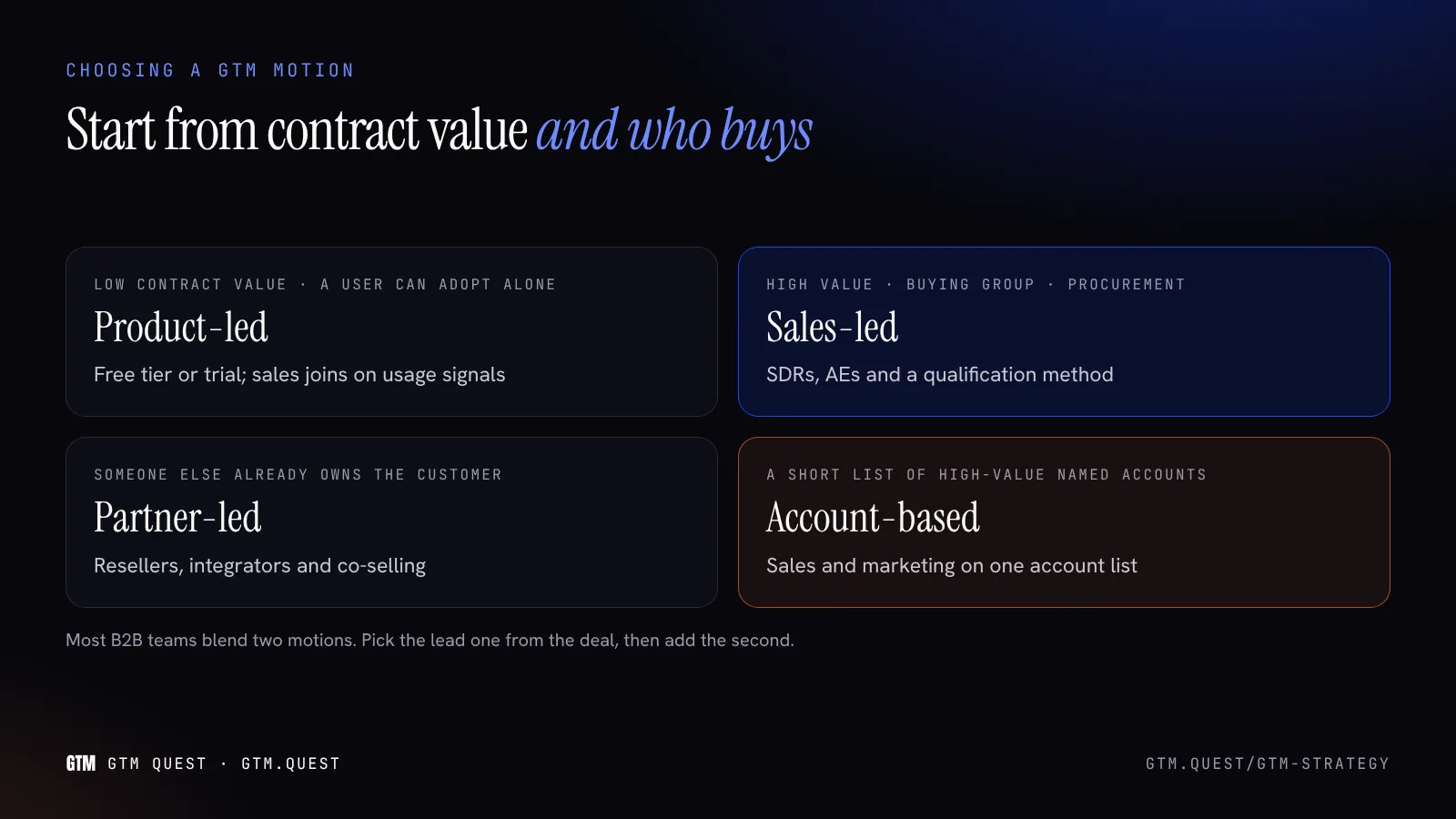
Choose your go-to-market motion sales-led, product-led, partner-led or ABM
Pick the description closest to your situation.
The motion should follow from your price, your buyers and your market, not from what a competitor does.
Which sounds most like your business?
Sales-led
A sales team runs the deal
Best when contracts are large enough to pay for sellers, the buying group is big and the product needs explaining.
With buying decisions involving 13 internal stakeholders, someone has to run the process.
- ✓ SDRs and AEs, or full-cycle sellers
- ✓ Discovery and qualification discipline
- ✓ Mutual action plans and pilots
- ✓ Multi-threading across the buying group
The Bridge Group's 2025 study of 351 B2B companies found a median of one SDR for every 2.4 AEs.
Product-led
The product acquires and converts
Best when a user can sign up, see value quickly and pay without a procurement process.
Gartner found 67% of B2B buyers prefer a rep-free experience, and product-led companies build for that.
Most add sales later for larger accounts, as Atlassian did.
- ✓ Free trial or freemium
- ✓ Self-serve pricing and checkout
- ✓ In-product activation
- ✓ Sales assist for expansion
Watch for the ceiling: deals above a certain size still need a person.
Partner-led
Partners carry the product to market
Best when resellers, agencies, platforms or associations already sell to your ICP, or the buyer wants local implementation.
Ebsta's 2025 benchmarks rank partner referrals the most efficient source of new business.
- ✓ Referral, reseller or marketplace model
- ✓ Partner enablement and margin
- ✓ Co-marketing
- ✓ Clear deal registration rules
Slower to start; partners need proof before they put their name on you.
Account-based
Sales and marketing work named accounts together
Best when the market is a finite list of high-value accounts.
McKinsey's 2026 B2B Pulse links market leaders to sales-led, account-based marketing governance alongside personalization and AI.
- ✓ Tiered target account list
- ✓ Personalized content per account
- ✓ LinkedIn ads to the buying group
- ✓ Shared pipeline targets
See account-based marketing strategy, or work with an ABM agency.
Most B2B companies run a hybrid: self-serve for small accounts, sales-led for the mid-market, account-based for the top tier.
Ebsta also found 46% of companies now expect sellers to prospect, close and grow accounts (full-cycle selling) rather than splitting the work across roles.
09/ by context
B2B go-to-market strategy for SaaS, startups and enterprise
The decisions are the same everywhere.
What changes is which one matters most.
B2B SaaS
SaaS go-to-market strategy
Recurring revenue makes retention part of go-to-market.
Expansion is cheaper than new logos: Ebsta found expansion deals closing in 52 days against 91 for new business, with a 45% expansion win rate against 19% for new logos.
Benchmarkit's 2025 median: $2.00 of sales and marketing spend per $1.00 of new customer ARR.
Startups
Go-to-market strategy for startups
Start with founder selling.
HBS calls this the initiation phase: not scalable, costly, and focused on learning how to sell.
Hire the first rep only when a repeatable process exists, and give them the notes.
Early CAC is often understated: founder time rarely gets counted.
Enterprise
Enterprise go-to-market strategy
Large deals mean large buying groups, procurement early and trials.
Forrester found procurement is a decision-maker in 53% of buying cycles and 78% of $10 million-plus buyers trial first.
Plan for the pilot, the security review and the business case from day one.
Ebsta: involving decision-makers early lifted win rates by 55% in its 2025 data.
10/ measurement
GTM metrics and benchmarks sourced figures only
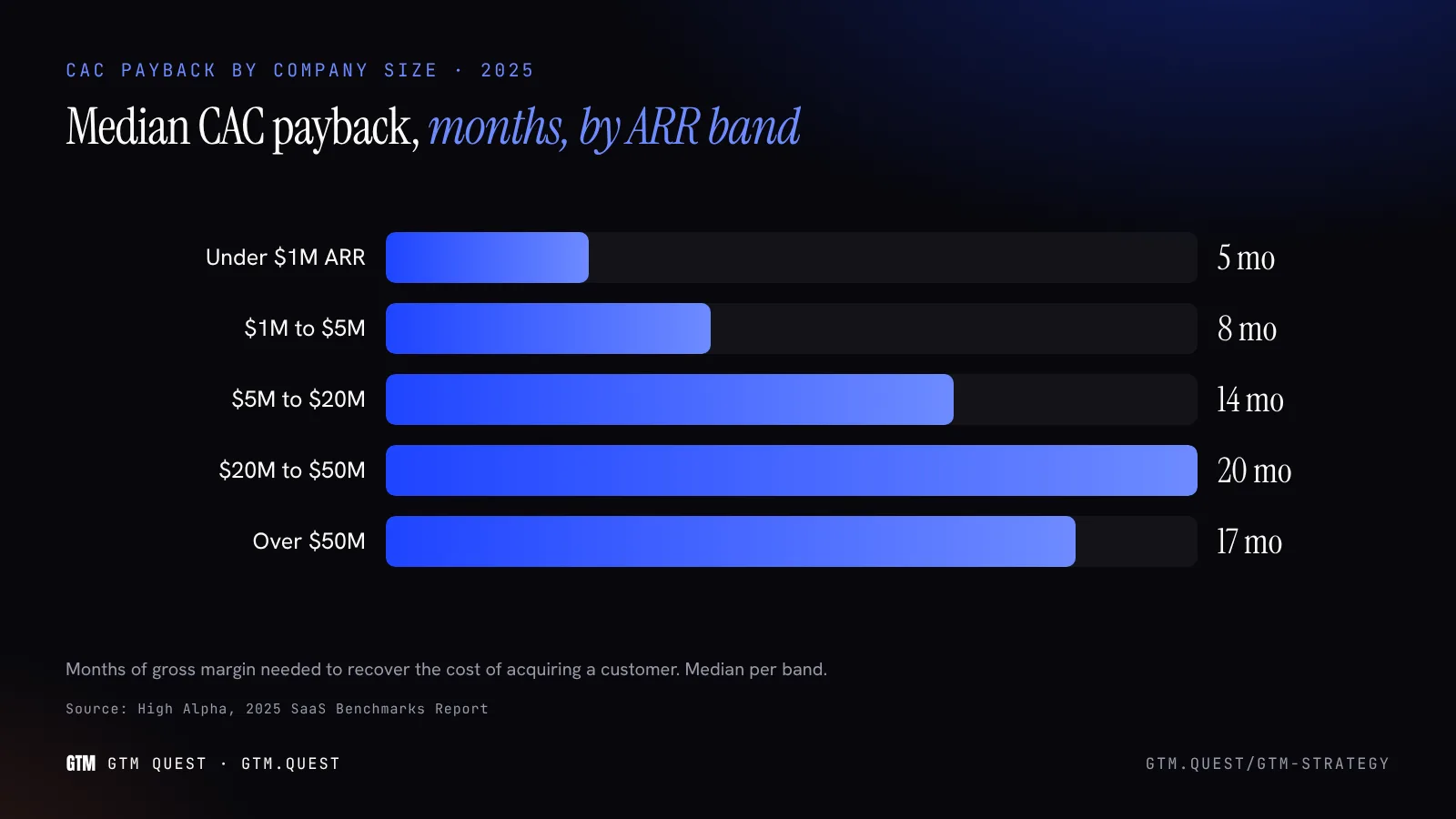
Set targets before launch and compare against your own baseline first.
External benchmarks tell you whether you are in a normal range, not what good looks like for you.
Context matters more than the median.
Benchmarkit notes the common wisdom that about 12 months CAC payback is good, but that the metric is highly correlated to ACV.
High Alpha warns that early-stage companies often leave founder salaries and onboarding costs out of CAC, which flatters payback.
SaaS Capital found growth rate is positively correlated with net revenue retention.
11/ what goes wrong
Common GTM strategy mistakes and how to avoid them
The failures we see most often are decisions skipped, not decisions made badly.
01
Targeting everyone
A broad ICP makes every message generic and every channel expensive.
Start with a beachhead you can win, then expand.
Dunford’s CRM example shows the payoff of narrowing.
02
Scaling before it repeats
Hiring a sales team before the process works burns money.
HBS's advice is to learn during the initiation phase before scaling.
03
Positioning by feature list
Listing features without naming the alternative they beat leaves buyers to compare you on price.
Start from competitive alternatives.
04
A price the motion cannot afford
Low prices with field sales, or enterprise prices with no sales support.
Check the price pays for the motion before launch.
05
Sales and marketing saying different things
Gartner found 69% of buyers see inconsistencies between what a supplier's website and its sellers say.
One positioning document, used by both.
06
Volume outreach instead of relevance
73% of B2B buyers actively avoid suppliers who send irrelevant outreach.
Fewer accounts, better research.
12/ our service
How GTM Quest builds your GTM strategy strategy that turns into pipeline
- 01
Evidence
We interview your won, lost and churned customers and analyze your CRM by segment.
WEEKS 1 TO 2 - 02
Decisions
ICP, positioning, pricing logic and motion, written up in the template above and agreed with sales.
WEEKS 2 TO 4 - 03
Golden list
The accounts that fit the ICP, deduplicated, matched to your CRM and ranked by signal.
CLAY · POSTGRES - 04
Channel tests
LinkedIn content and ads, signal-led outbound and ABM plays, in small batches with a number attached.
WEEKS 4 TO 8 - 05
Measurement
Weekly pipeline, win rate and cycle by segment and source, and a quarterly strategy review.
WEEKLY - 06
Run or hand over
We run it with you, or document it for your team and hand it over.
YOUR CHOICE
We are a GTM agency in London working with UK and US B2B teams.
Our own stack, the Quest System, is Neon Postgres, Clay and Claude Code; the systems side is described on our GTM engineer page.
13/ getting help
When to bring in a GTM consultant or a go-to-market agency and when not to
Do it yourself when the founders still sell every deal and have time to interview customers.
The template above and the HBS steps are enough.
Bring in help when the decisions are clear but no one has time to execute, or when the team disagrees on the decisions themselves.
A GTM consultant fits when you need the strategy written, tested and agreed, and your own team will execute it.
See our guide to choosing a GTM consultant.
A go-to-market agency fits when you also need the execution: lists, outbound, content, ads and reporting.
Our explainer covers what a go-to-market agency does.
For named-account programs, an ABM agency is the specialist option.
A fractional leader fits when you need someone senior to own go-to-market for a year before you hire full-time.
Our sister site lists fractional GTM leaders, and our guide to the fractional CMO role explains the trade-offs.
Whichever you choose, ask for three things: written decisions, not slides; tests with numbers attached; and everything built in accounts you own.
15 minutes · video or phone
Book 15 minutes on your GTM strategy
Tell us who you sell to today, what a typical deal looks like and where pipeline stalls. We come back with the two decisions we would test first, whether or not you work with us.
- 0115 minutes, video or phone
- 02We look at your ICP, deals and channels
- 03A written next step after the call
- 04Strategy only, or strategy plus the pipeline system
Pick a day that suits · live availability
14/ questions
GTM strategy FAQ
What people search for about go-to-market strategy, answered with sources.
A plan for how a company reaches its target customers effectively and efficiently.
HBS Online defines it as "a detailed plan of how your startup will reach its target customers".
See the definition.
GTM means go-to-market.
A GTM strategy is the set of choices about market, positioning, pricing, channels and sales motion that decide how a product reaches buyers.
See GTM strategy meaning.
Seven decisions: market and ICP, problem and positioning, pricing and packaging, channels, sales motion, enablement, and metrics.
See the seven decisions.
Research, choose the beachhead and ICP, position, price, pick the motion and channels, test in small batches, then measure and scale what works.
See GTM strategy steps.
Atlassian's filings describe a land-and-expand model with self-serve landing and a sales force for large-account expansion.
See real examples and a filled-in hypothetical.
Yes.
Our one-page GTM strategy template lists 14 elements, the question each answers, and the evidence to attach.
The strategy is the choices; the plan is the schedule that executes them, usually 90 days at a time with owners and budgets.
Revisit the strategy quarterly and rewrite the plan each quarter.
The marketing side of go-to-market: positioning, messaging, content, paid and events aimed at the ICP.
It should come from the same strategy as sales, since Gartner found 69% of buyers see inconsistencies between supplier websites and sellers.
The sales side: segments, territories, the sales motion, qualification and handoffs.
See choose your motion.
Founder-led sales in one segment first, then a first sales hire once the process repeats.
HBS calls this the sales learning curve.
See GTM for startups.
A GTM consultant if your team will execute; a go-to-market agency if you also need execution.
See when to get help.

Book 15 minutes · London · UK and US
Bring your ICP and your last ten deals. We’ll show you which decision to test first.
A 15-minute call, a written next step, and a GTM strategy built with you, tested on real accounts and then run together or handed over.
16/ sources
Every source on this page
Each figure above links to one of these. All were opened and checked on October 16, 2026.
- Forrester, The State of Business Buying, 2026 (press release, Jan 2026)forrester.com
- Gartner, 67% of B2B buyers prefer a rep-free experience (March 2026, 646 buyers)gartner.com
- Ebsta and Pavilion, 2025 GTM Benchmarks Report (PDF)benchmarks.ebsta.com
- SaaS Capital, 2025 B2B SaaS Retention Benchmarks (Research Brief 32)saas-capital.com
- HBS Online, How to Develop a Go-to-Market Strategy for Your Tech Venture (Catherine Cote, July 2023)online.hbs.edu
- High Alpha, 2025 SaaS Benchmarks Report (PDF)2994607.fs1.hubspotusercontent-na1.net
- Stripe, What is a go-to-market strategy? (updated March 2026)stripe.com
- Gartner, 61% of B2B buyers prefer a rep-free buying experience (June 2025, 632 buyers)gartner.com
- Gartner, The B2B buying journeygartner.com
- McKinsey, The surprising economics of B2B growth: 2026 Global B2B Pulse Survey (May 2026)mckinsey.com
- LinkedIn, Why you should follow the 95-5 rule (May 2022)linkedin.com
- April Dunford, A quickstart guide to positioningaprildunford.com
- April Dunford, A product positioning exerciseaprildunford.com
- Atlassian, Form 10-K for fiscal year ended June 30, 2022 (SEC)sec.gov
- Atlassian, Form 10-K for fiscal year ended June 30, 2026 (SEC)sec.gov
- ColdIQ, AirOps case study (agency case study)coldiq.com
- The Bridge Group, SDR Models, Motions & Metrics: 2025 Research Report (351 companies)bridgegroupinc.com
- Benchmarkit, 2025 SaaS Performance Metricsbenchmarkit.ai
- Fractional Quest, Fractional GTMfractional.quest