
CRM comparison · prices checked October 16, 2026
HubSpot vs Salesforce which CRM fits your go-to-market
HubSpot is one platform with a shared CRM and "hubs" you switch on as you grow.
Salesforce is a configurable platform with separate clouds, a large partner ecosystem and more room for complex processes.
Both run serious B2B revenue teams.
The right choice depends less on features than on your company's shape: who generates pipeline, how complex your territories and approvals are, and who will run the system.
This guide compares list prices from each vendor's own page, the real cost drivers, and how each one is built, then gives our view from GTM builds in both.
Reviewed by Dan Keegan, GTM Quest · October 16, 2026 · 19 sources linked below
How we run a CRM decisionbefore anyone signs a contract
- 01Map the motion and the dataWEEK 1ICP · PIPELINE · OBJECTS
- 02Price both at your seat countWEEK 1LIST · ONBOARDING · ADMIN
- 03Pilot the hardest workflowWEEKS 2 TO 3ROUTING · REPORTING
- 04Decide, then buildWEEK 4 ONHUBSPOT · SALESFORCE
Platforms we build in2
01/ the short answer
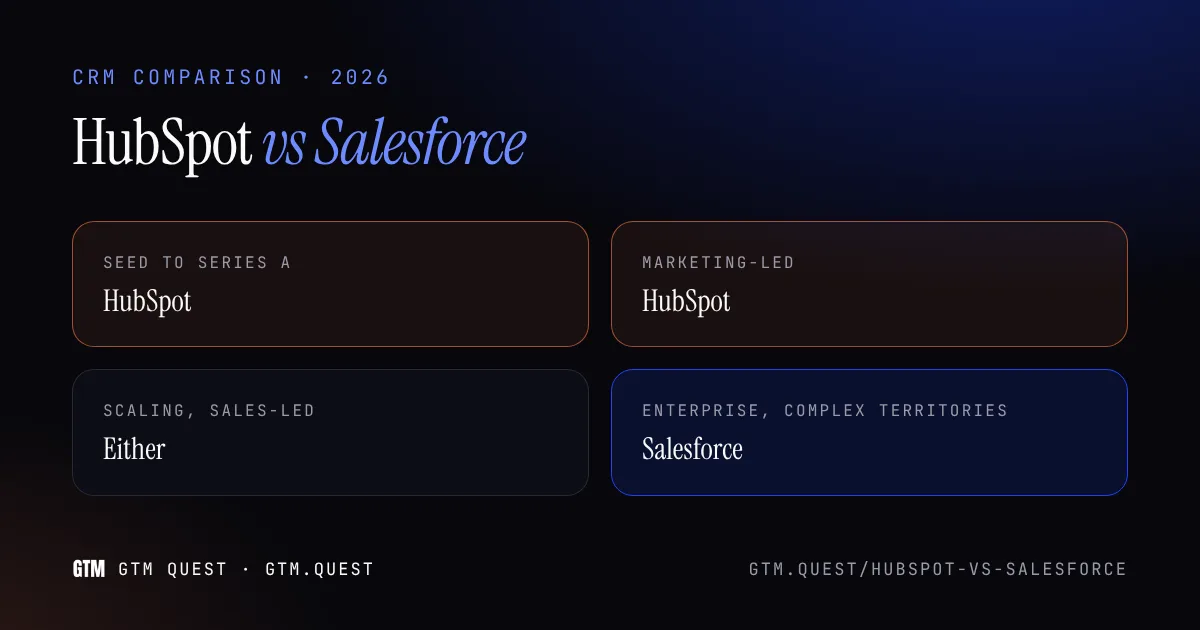
HubSpot vs Salesforce the short answer by company shape
Four shapes cover most of the B2B companies we meet.
Find yours, then read the sections that test it.
Seed to Series A, founder-led or small sales team: HubSpot, in most cases.
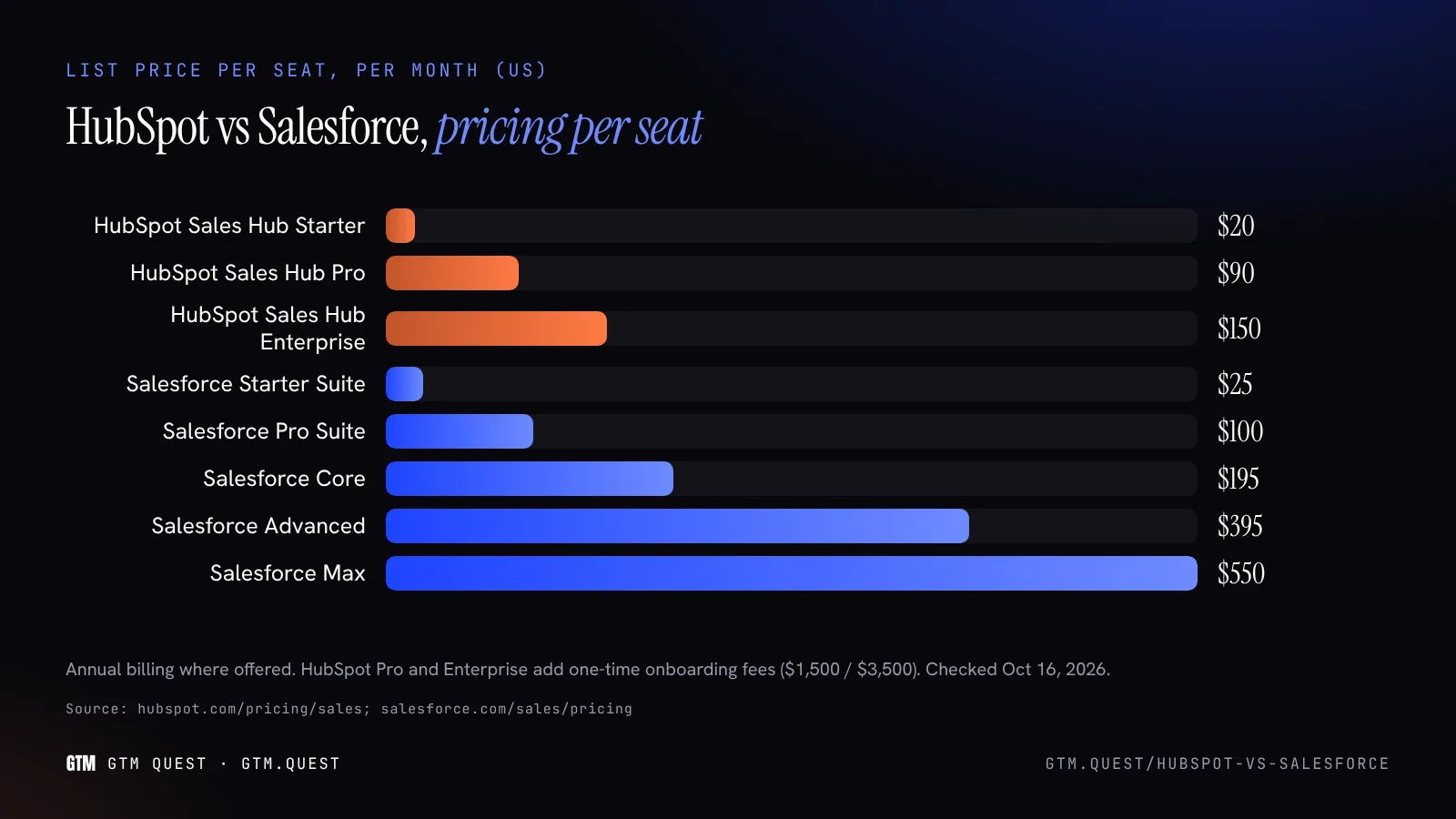
The free tools and Starter tier let you run a real pipeline without an admin, and HubSpot's Starter list price is $20 per seat per month.
Salesforce's Starter Suite is $25 per user per month and is a fair alternative if you already know you will grow into Salesforce.
Scaling sales-led B2B (roughly 10 to 100 sellers): genuinely either.
HubSpot Sales Hub Professional and Salesforce Pro Suite or Core sit in the same price band at list.
Pick on data model and who will run it: HubSpot if marketing and sales share one team and one admin, Salesforce if you expect complex objects, approvals or CPQ.
Enterprise with complex territories, hierarchies or regulated data: Salesforce, usually.
Its editions add sandboxes, territory and split features, and deep configuration through Flow and Apex, and its partner ecosystem is built for multi-year programs.
HubSpot Enterprise has narrowed the gap, so test your hardest workflow in both before assuming.
Marketing-led company (inbound, content, product-led): HubSpot, because marketing automation and the CRM are one database.
With Salesforce you would usually add Marketing Cloud or another tool and an integration to keep in sync.
02/ architecture
How each one is built one platform vs a platform of clouds
Most of the practical differences, from admin effort to integration cost, follow from architecture.
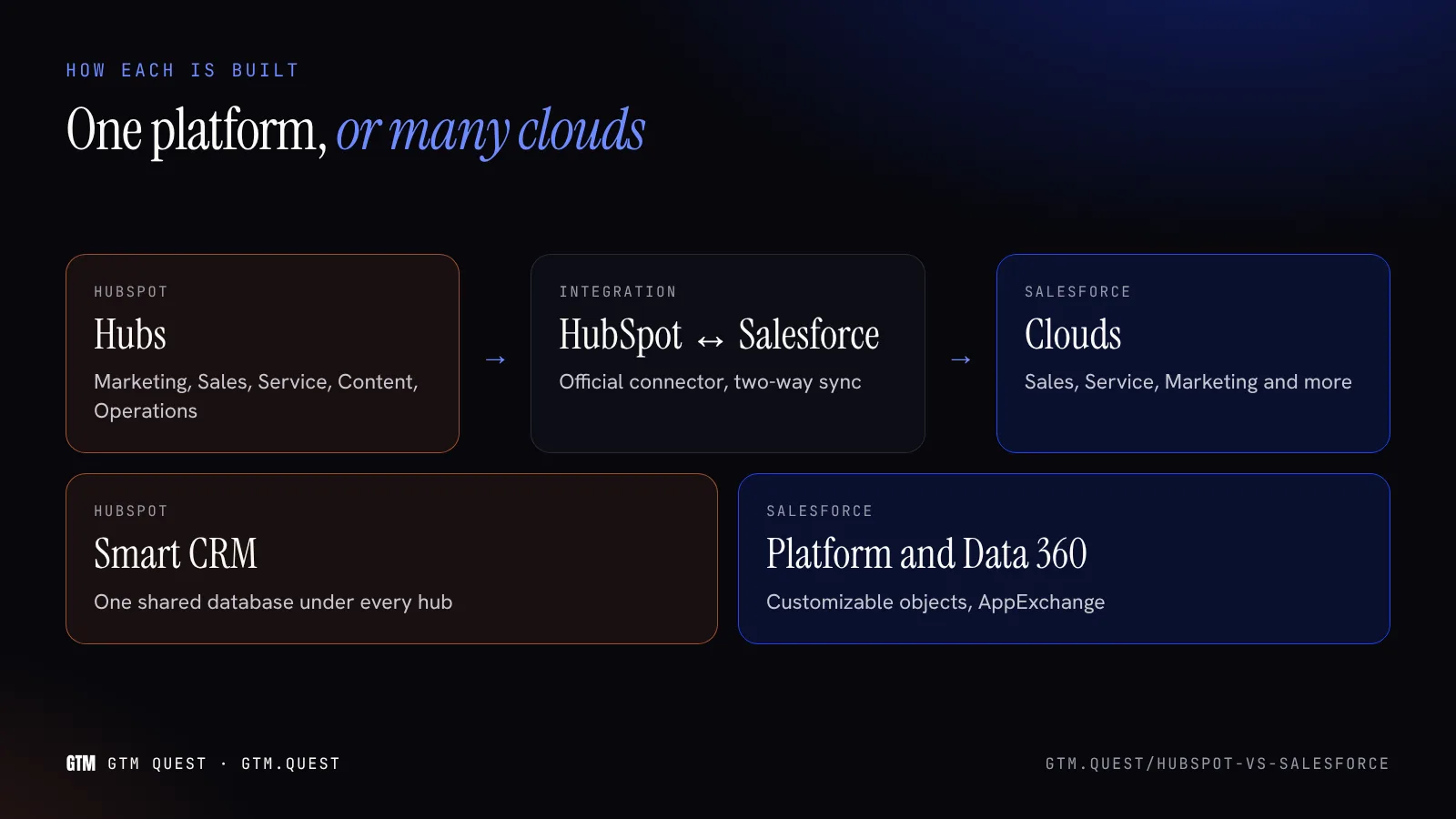
Both vendors now describe themselves as one unified platform.
What sits underneath is different, and it decides how you buy, configure and staff each one.
HubSpot: one CRM, several hubs
HubSpot says its customer platform unifies marketing, sales, and service teams on an AI-powered Smart CRM.
The hubs (Marketing, Sales, Service, Content, Data and Revenue) are products bought per tier on top of that one database, and Smart CRM features are included with any premium product, or can be bought on their own.
The consequence: a lead captured by a marketing form, a sequence a seller sends and a support ticket all land on the same contact record without a sync.
HubSpot's App Marketplace carries apps, agents and Solutions Partners for what the hubs do not cover.
Salesforce: Customer 360 on the Salesforce Platform
Salesforce sells separate clouds (Sales Cloud, Service Cloud, Marketing Cloud, Revenue Cloud and more) alongside Tableau, MuleSoft, Slack and Data 360, which it says unifies your data across systems with Zero Copy integration.
It calls the result Customer 360 and describes Agentforce as deeply integrated with the Salesforce Platform.
The Salesforce Platform is the part that matters most for complex teams: custom objects, page layouts, record types, Flow automation and Apex code, all configured as metadata.
Its marketplace, long known as AppExchange, now presents itself as AgentExchange, which Salesforce calls a unified marketplace for apps, agents, and Slack solutions.
03/ pricing
HubSpot pricing Sales Hub and Smart CRM, list prices
From HubSpot's own pricing pages and Product & Services Catalog, checked October 16, 2026.
List prices change and HubSpot runs promotions, so check the live page before you budget.
Sales Hub or Smart CRM? Sales Hub seats carry the selling tools (sequences, forecasting, conversation intelligence).
Smart CRM seats give the CRM itself without them, which suits managers, finance or operations users.
Since March 5, 2024, HubSpot says Sales Hub for new customers is priced per seat with no additional seat minimums.
UK prices. HubSpot shows other currencies through a selector on its pricing page.
We could not read the GBP figures reliably on October 16, 2026, so we do not quote them; check HubSpot's pricing page with GBP selected.
04/ pricing
Salesforce pricing Sales Cloud editions, US and UK list prices
From Salesforce's Sales pricing page, checked October 16, 2026.
Salesforce says the page is "provided for information purposes only and subject to change".
All figures above are from Salesforce's Sales pricing page.
Salesforce offers a 30-day free trial of Sales Cloud editions and says most products use annual contracts.
Edition names have changed. The current page lists Core, Advanced and Max; older guides, and parts of Salesforce's own documentation, still refer to Professional, Enterprise and Unlimited.
If you are renewing, ask your account executive which current edition your contract maps to.
Add-ons on the same page: Agentforce for Sales from $125 per user per month; Web Services API on Pro Suite at an additional $25 per user per month; and the Premier Success Plan at 30% of net license fees.
05/ total cost of ownership
What it really costs the drivers beyond the seat price
The license is usually the smaller part of year one.
These are the cost lines both vendors publish, plus the ones they do not.
For example, 10 sellers in year one at US list price (our arithmetic on the published figures, before tax, promotions, add-ons or partner fees): HubSpot Sales Hub Professional is 10 × $90 × 12 + $1,500 onboarding = $12,300; Sales Hub Enterprise is 10 × $150 × 12 + $3,500 = $21,500.
Salesforce Pro Suite is 10 × $100 × 12 = $12,000, or $15,000 with the API add-on; Core is 10 × $195 × 12 = $23,400; Advanced is $47,400.
Admin time and partner fees are not published by either vendor, so we do not put numbers on them.
They are the lines that most often decide the total.
Get a written partner quote for each platform before you compare.
06/ side by side
HubSpot vs Salesforce compared data, reporting, automation, AI, integrations
Pick an area.
Each row is what the vendor publishes for its own product; the line underneath is our reading of it.
→ If your business has objects that do not look like contacts and deals (assets, contracts, sites, policies), Salesforce models them more naturally. If it does not, HubSpot's simpler model is an advantage, not a gap.
→ HubSpot reporting is easier to build and read, because marketing and sales data share one record. Salesforce wins when finance needs multi-level roll-ups, territories and splits that match a complex org chart.
→ HubSpot workflows are quicker for a non-developer to build and maintain. Salesforce Flow and Apex handle branching, multi-object logic that HubSpot either cannot do or does only with custom code.
→ Both connect to the tools a GTM stack needs (Clay, sequencers, data providers, warehouses). Salesforce goes further into ERP and back-office systems; HubSpot gets you connected faster with less engineering.
07/ AI
HubSpot Breeze vs Salesforce Agentforce what each vendor says its AI does
Both vendors are moving fast and naming things often.
This is what each one says on its own pages today.
HubSpot. HubSpot describes Breeze Assistant as a conversational assistant that supports sales, marketing, and service teams, and Breeze features as AI embedded in particular HubSpot tools.
Its agents now sit in Agent Hub, which HubSpot says is included in all Starter, Professional, and Enterprise editions, with many agents running on HubSpot Credits.
Sales Hub tiers list a Prospecting agent, Agent Builder and a Notetaker from Starter (HubSpot).
Salesforce. Salesforce describes Agentforce as a suite of customizable agents and tools that can be personalized with prompt templates, Flows and Apex and that act on CRM data and metadata.
In Sales Cloud, agents for lead nurture, pipeline management and prospecting are available for purchase on Core and Advanced and included in Max, and actions draw on Flex Credits.
How it is paid for. HubSpot includes a credit allowance by tier and sells more in packs or pay-as-you-go.
Salesforce prices Agentforce several ways, including Flex Credits at $500 per 100K, $2 per conversation, and flat-fee access at $125 per user per month.
08/ implementation
Implementation how long it takes and who you need
Neither vendor publishes a standard implementation time for new customers, so we do not quote one.
What both do publish is who is involved.
Write the requirements before the build
List your objects, pipelines, routing rules, reports and integrations, and name the owner of each.
This document is the same whichever platform you pick, and it is what partners quote against.
- ✓ Objects and fields
- ✓ Pipelines and stages
- ✓ Routing and ownership
- ✓ The five reports leadership reads
HubSpot onboarding plus a partner if needed
Professional and Enterprise require paid onboarding (HubSpot).
HubSpot says its onboarding plan is designed around your goals, the size and complexity of your organization, the products you bought and your current stack.
Many teams add a Solutions Partner for data migration and integrations.
- ✓ A named internal owner
- ✓ HubSpot onboarding specialist
- ✓ Optional Solutions Partner
- ✓ See our HubSpot partner guide
An admin, and usually a partner
Salesforce points buyers to Professional Services and Salesforce Certified Partners and to Success Plans for ongoing guidance.
In practice a Salesforce build needs a certified admin from day one and a developer for anything in Apex.
- ✓ Salesforce admin
- ✓ Implementation partner
- ✓ Developer for Apex and integrations
- ✓ Success Plan for support
Launch with one team, then widen
Go live with one sales team and a short list of reports, fix what breaks, then add marketing, service or new regions.
Big-bang launches are where adoption fails.
- ✓ Pilot team first
- ✓ Training on real records
- ✓ Weekly fix list
- ✓ Adoption tracked by activity
Our view on timing. For a 10 to 30 seat sales team with clean data, a HubSpot Professional build is usually a matter of weeks; a Salesforce build with custom objects, CPQ or territories is usually measured in months.
The variable is your data and integrations, not the platform.
Our HubSpot partner agencies and revenue operations agencies pages list firms that do this work.
09/ migration
Migrating between HubSpot and Salesforce in either direction
Most migrations fail on associations and history, not on contacts.
Plan the mapping before the export.
Whichever way you move, export and keep a full backup, map every object and field first, and decide what history you will carry (emails, calls, notes, closed deals).
Moving bad data into a new CRM only gives you the same problems in a new interface.
Salesforce to HubSpot
HubSpot recommends a phased approach while both systems are turned on and says it typically sees most businesses complete the migration within three months.
It also suggests re-defining your architecture, consolidating integrations and rebuilding automation in HubSpot workflows rather than copying it.
The official HubSpot-Salesforce integration can run both systems side by side during the move.
It requires HubSpot Professional or Enterprise and a Salesforce edition with API access; HubSpot notes records do not sync automatically after setup and a single contact sync can take up to four API calls.
HubSpot to Salesforce
Salesforce's in-browser Data Import Wizard handles up to 50,000 records for accounts, contacts, leads, campaign members and custom objects.
Above that, or for scheduled loads and complex mappings, Salesforce points to Data Loader, and Trailhead lists it for Enterprise, Unlimited, Performance and Developer editions.
HubSpot's model is flatter than Salesforce's: decide early whether HubSpot contacts become Salesforce leads or contacts, and how companies map to accounts.
Getting that wrong is the most common reason a migration has to be re-run.
10/ decision
HubSpot or Salesforce? pick your scenario
Four scenarios we see most often, with the choice we would make and why.
Which best describes your company today?
Usually HubSpot
Seed-stage SaaS: start on HubSpot
A founder or two sellers, inbound and outbound mixed, no RevOps hire.
You need a pipeline, sequences and clean records more than you need configuration.
- ✓ Free tools for up to 2 users, then Starter at $20 list per seat ([HubSpot](https://www.hubspot.com/products/crm/starter))
- ✓ Move to Sales Hub Professional when you need sequences and forecasting
- ✓ Set up the data model as if you will have 50 sellers
- ✓ Salesforce Starter Suite is a fair alternative if your investors or buyers expect it
See our SaaS marketing agencies guide for the go-to-market around it.
Either: decide on data model
Scaling sales-led B2B: pilot both
Ten to a hundred sellers, a few segments, a RevOps owner, outbound alongside inbound.
Both platforms work; cost and complexity at list are close.
- ✓ Sales Hub Professional vs Salesforce Pro Suite or Core
- ✓ Pilot your hardest workflow: routing, approvals or forecast roll-up
- ✓ Price an admin and a partner for each
- ✓ Pick the one your RevOps lead can run without a developer
Our revenue operations agencies page lists firms that can run the pilot.
Usually Salesforce
Enterprise with complex territories: Salesforce
Multiple regions and business units, territory and split rules, CPQ, a finance team that needs forecast roll-ups by hierarchy, and integrations into ERP.
- ✓ Advanced or Max for sandboxes and data capacity ([Salesforce](https://www.salesforce.com/sales/pricing/))
- ✓ A certified admin and an implementation partner from the start
- ✓ Agentforce priced by usage, so model it before you sign
- ✓ Test HubSpot Enterprise only if your objects are simple
For account-based programs on top of it, see our ABM agency page.
Usually HubSpot
Marketing-led company: HubSpot
Inbound, content and events produce most pipeline, and marketing owns the funnel up to the sales handoff.
One database for marketing and sales matters more than deep configuration.
- ✓ Marketing Hub and Sales Hub on one Smart CRM
- ✓ Lead scoring and routing without a sync
- ✓ Attribution reports marketing and sales both trust
- ✓ Revisit Salesforce only if sales complexity outgrows HubSpot
See our marketing automation agencies guide.
Not sure which shape you are?
Our GTM scorecard takes seven questions, or a GTM consultant can run the comparison with you.
11/ our view
What we see in GTM builds practitioner guidance, labeled as our view
GTM Quest builds pipeline systems on both platforms: ICP, Clay enrichment and signals, routing, outbound and reporting.
These are our opinions from that work, not vendor claims or survey findings.
Our view
The CRM is rarely the problem
Most "we need to switch CRM" conversations are really about dirty data, unclear ownership and too many fields.
Fix those first; a migration will not.
Our view
Choose by who will run it
A HubSpot instance with a part-time owner beats a Salesforce org nobody administers.
If you cannot fund an admin, do not buy the platform that needs one.
Our view
Keep enrichment outside the CRM
We run Clay and our own Postgres database next to the CRM, then write the useful fields back.
Your scoring and history then survive a CRM change.
See GTM engineering.
Our view
Price year two, not year one
Promotions end, seats grow and AI usage scales.
Model renewal at list price and at double your seat count before you sign either contract.
Our view
Pilot the hardest workflow
Demos show the easy path.
Ask each vendor or partner to build your messiest routing or forecast rule with your own records, and watch who maintains it.
Our view
Hybrid is fine for a while
HubSpot for marketing with Salesforce for sales is common and works, if one system owns each field.
Without that rule, the sync becomes a second job.
This is the work we do as a GTM agency: we help you choose, build the CRM and the systems on top, then run them with you or hand them over.
For what a go-to-market agency does beyond the CRM, read our guide.
15 minutes · video or phone
Book 15 minutes on your CRM decision
Tell us your seat count, your sales motion and what your current CRM gets wrong. We come back with which platform we would pick, what it would cost at list price, and what to build first, whether or not you work with us.
- 0115 minutes, video or phone
- 02Independent: we build in both
- 03A written recommendation after the call
- 04Selection, build, migration or rescue
Pick a day that suits · live availability
12/ questions
HubSpot vs Salesforce FAQ
What people search for when they compare the two CRMs, answered with sources.
Neither is better in general.
HubSpot is usually the better fit for small and marketing-led teams that want one platform without a dedicated admin; Salesforce for complex, multi-team organizations.
See the short answer.
At entry level they are close: HubSpot Starter lists at $20 per seat and Salesforce Starter Suite at $25 per user.
At the top, Sales Hub Enterprise is $150 per seat against $195 to $550 for Salesforce Core to Max; admin and partner costs usually widen the gap.
See total cost.
Sales Cloud runs from $25 per user per month for Starter Suite to $550 for Max, billed annually above Starter, as of October 16, 2026.
Add-ons such as Agentforce for Sales start at $125 per user per month.
Sales Hub Professional is $90 per seat per month billed annually or $100 monthly, plus $1,500 onboarding; Enterprise is $150 per seat plus $3,500 onboarding.
Starter lists at $20, with a limited-time promotion for new customers.
Salesforce publishes GBP prices: £20 Starter Suite, £80 Pro Suite, £156 Core, £316 Advanced and £440 Max per user per month.
HubSpot's GBP prices sit behind a currency selector on its pricing page.
Salesforce's comparison table lists a Free Suite at $0, and it offers a 30-day free trial of Sales Cloud editions.
HubSpot's free tools cover up to 2 users.
Yes.
The official integration syncs contacts, companies, deals and activities, and needs HubSpot Professional or Enterprise and a Salesforce edition with API access.
It does not support Salesforce Group Edition.
HubSpot, in most cases, because one platform holds marketing and sales and a non-specialist can run it.
Salesforce Starter Suite is built for small teams too; the difference shows up when you customize.
See the picker.
Salesforce is the usual enterprise choice for complex territories, custom objects and ERP integration, with sandboxes in Core and above.
HubSpot Enterprise adds custom objects, sandboxes and field-level permissions, so test your hardest workflow in both.
Map objects and fields, back up everything, then run both systems in parallel through the official integration.
HubSpot says most businesses complete the move within three months.
See migration.
Breeze is HubSpot's assistant and embedded AI, with agents in Agent Hub included in paid editions and run on credits.
Agentforce is Salesforce's agent suite, customizable with Flows and Apex and priced by Flex Credits, conversations or per user.
See AI.
For HubSpot Professional and Enterprise, onboarding is required and paid; a partner is optional.
For Salesforce beyond Starter or Pro Suite, most teams use an admin and an implementation partner.
See our HubSpot partner agencies list.

Book 15 minutes · London · UK, US and Europe
Bring your seat count and your messiest workflow. We’ll tell you which CRM we would pick.
A 15-minute call, a written recommendation, and a CRM and GTM system built in whichever platform fits, then run together or handed over.
14/ sources
Every source on this page
Each figure above links to one of these. All were opened and checked on October 16, 2026.
- Salesforce, Sales pricing (checked Oct 16, 2026)salesforce.com
- HubSpot, Sales Hub pricing (checked Oct 16, 2026)hubspot.com
- HubSpot, Switching from Salesforce to HubSpothubspot.com
- HubSpot, Starter plan and current promotionhubspot.com
- HubSpot, Products and customer platformhubspot.com
- HubSpot, Product & Services Cataloglegal.hubspot.com
- HubSpot App Marketplaceecosystem.hubspot.com
- Salesforce, Productssalesforce.com
- Salesforce AppExchange is now AgentExchangeappexchange.salesforce.com
- Salesforce, AgentExchange (formerly AppExchange)salesforce.com
- HubSpot, Free tools and Starter pricinghubspot.com
- Salesforce, Agentforce pricingsalesforce.com
- HubSpot, AI model cards (Breeze Assistant and Breeze features)trust.hubspot.com
- HubSpot, Agent Hubhubspot.com
- HubSpot Knowledge Base, Manage HubSpot Creditsknowledge.hubspot.com
- HubSpot, Onboarding serviceshubspot.com
- HubSpot Knowledge Base, Connect HubSpot and Salesforce (updated June 18, 2026)knowledge.hubspot.com
- Salesforce Trailhead, Manage data at scaletrailhead.salesforce.com
- Salesforce Developers, When to use Data Loaderdeveloper.salesforce.com