
Repeatable hiring
A specialist recruiter can source a clearly defined role. Ask who screens candidates, how duplicate introductions are handled and which terms trigger payment.
GTM recruitment · GTM recruiters · executive search · 2026
GTM recruitment agencies hire go-to-market people across sales, marketing, customer success, partnerships and revenue operations, including specialist GTM engineering roles.
GTM Quest is a GTM recruitment agency: we recruit GTM people and build the systems they run.
You can also engage Dan Keegan directly as your GTM expert.
Choose from the role, your stage and how you sell, then compare the search agreement and specialists worth knowing.
See live GTM jobs for current roles; our sister site Fractional Quest covers fractional and interim GTM leaders.
Reviewed by Dan Keegan, GTM Quest · 28 September 2026 · 34 sources linked below
Module 01 / 03
Module 02 / 03
Module 03 / 03
01/ definitions
GTM recruitment is hiring go-to-market talent: the people who find buyers, win them and keep them, and the people who run the systems behind that.
It covers sales, marketing, customer success, partnerships, revenue operations and specialist GTM engineering roles, as described across Certus recruitment coverage and BisonRS operations specialisms.
A GTM recruiter specialises in those roles.
The difference from a generalist is knowing what separates an SDR from an AE, a RevOps manager from a GTM engineer, and a founder-led seller from an enterprise closer.
Ask for examples of the work candidates created themselves and what infrastructure they inherited.
A GTM recruitment agency is the firm that runs those searches under an agreed commercial model.
A go-to-market recruiter usually means one who works across the whole GTM function rather than one discipline.
"GTM hiring" is the same thing from the employer's side: building a go-to-market team role by role.
The mistake we see most is hiring for headcount before there is a system to run: sellers with no list, a GTM engineer with no ICP.
A GTM recruiter specialises in go-to-market hiring across sales, marketing, customer success, partnerships and the operations behind them.
02/ our service
Yes: we recruit GTM roles, and Dan Keegan can be engaged directly as a GTM expert.
01
Use our GTM recruitment agency service to agree the role, assess candidates and run the search.
02
Work directly with Dan as a GTM expert, with the problem, responsibilities and engagement terms agreed before work starts.
03
Name the outcomes, tools and stage experience the role requires, including the decisions the person can control.
04
We can build the account data, workflows and CRM processes the person will run, with handover included in the scope.
05
Use the specialists below to compare stated role coverage; we take no referral fees.
06
Specify documentation, walkthroughs and ownership of lists, workflows and sequences before the engagement starts.
Every engagement is scoped and quoted in writing after the discovery call.
For the whole service, see how we work as a GTM agency.
03/ the fork
Compare GTM recruiting firms and your own hiring capacity, then decide whether you need recruitment, expert support or system work.
Which describes your hire best?
GTM recruitment agency
Ask which role and market the agency covers, how it assesses candidates and what triggers payment.
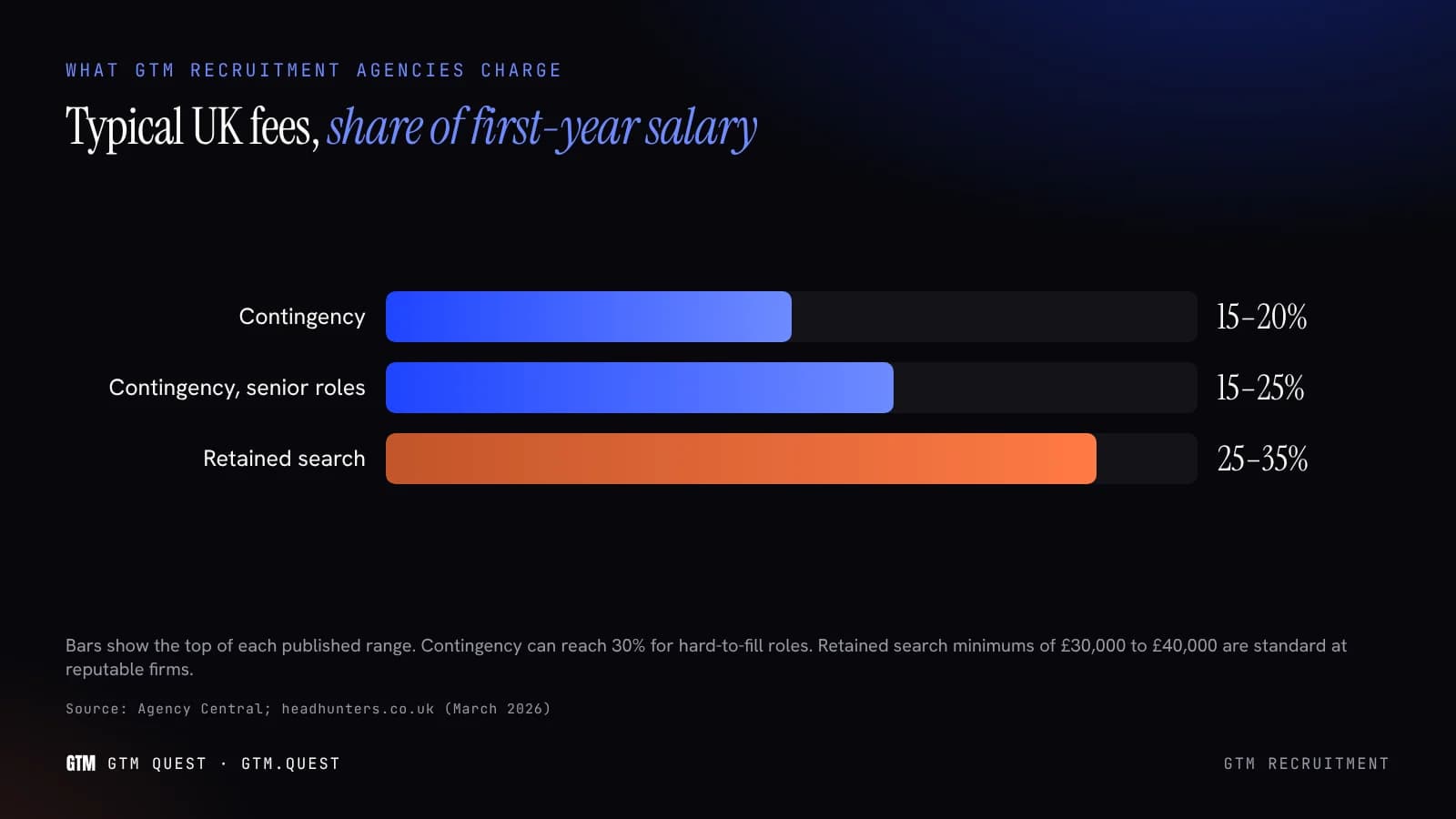
Published UK contingency ranges are 15% to 20% of first-year salary, up to 30% for hard-to-fill roles; confirm the actual written agreement.
GTM Quest can run the search: see our GTM recruitment agency.
Executive search
For a CRO, VP sales or RevOps leader, ask for the market map, assessment method and confidentiality arrangements.
Published retained ranges are 25% to 35% of first-year base salary; executive search describes the remit, while the agreement sets the commercial terms.
Confirm exclusivity and deliverables in writing.
In-house recruiter
An internal recruiter can build knowledge of the business across repeated searches; compare the workload, specialist reach and total employment cost with external support.
Use your hiring plan to compare the options.
Responsibility and scope
You can engage Dan Keegan directly as a GTM expert, with scope and engagement terms agreed on the call.
For a broader fractional or interim leadership search, our sister site Fractional Quest can take the brief.
See fractional CRO roles and CRO recruitment.
System and hiring
If the ICP, account data or workflows are missing, include that operating work in the brief.
We start the GTM motion on day one and build the system around it, with ownership and handover agreed alongside recruitment.
Discuss the person and the system together. Book a call.
Working arrangement and search model are separate decisions: permanent, interim and fractional describe the role, while contingency, retained and outsourced recruitment describe the search.
A GTM advisor can help define the responsibility before you commission it.
04/ stage and motion
Start with the missing capability and the motion the person will inherit; Certus describes matching candidates on stage, sales motion and built versus inherited infrastructure.
The choices below are our recommended questions, not a fixed order of hires.
What needs to change?
Build the motion
Where the founder still sells and the process is being discovered, ask for evidence of creating a motion with limited support.
Repeatable work
Assess whether the candidate has worked with comparable buyers, deal complexity, sales cycles and support; do not treat the title alone as proof of fit.
New context
For a new geography, partner channel or buyer group, ask which part of that change the candidate has owned before.
RevOps or GTM engineering
If routing, CRM data or reporting is the constraint, assess operations capability before assuming another seller is the answer; BisonRS describes coverage across RevOps, partner operations, GTM systems and engineering.
Expert or leader
Dan Keegan can be engaged as a GTM expert.
For other leadership arrangements, our sister site covers the founding GTM lead and fractional head of sales roles.
For technical assessment, see our GTM engineer guide and GTM engineer recruiter service; the State of GTM Engineering reported 84% of GTM engineers use Clay, which is tool context rather than proof of candidate skill.
For staffing context, the Bridge Group reported 3.0 months average SDR ramp, 40% median annual attrition and one SDR to 2.4 AEs in a sample of 351 B2B companies, mostly North American; these are not a prescribed team structure.
BisonRS previously published a London RevOps manager salary range; check its current scope before comparing an offer.
05/ the money
The figures below are published market ranges, not GTM Quest prices or a quote for your search; these sources were last checked on 28 September 2026.
Confirm the basis, payment triggers and rebate terms in writing.
Do not infer the search model from seniority alone: agree the work, confidentiality and commercial terms for the assignment.
Contingency describes payment on hire, not necessarily a non-exclusive agreement: Strive describes exclusive pay-on-success, retained, executive and outsourced recruitment.
Indeed explains contingency and retained payment models; confirm the triggers in your own agreement.
Under the REC's code, member agencies must disclose all fees, charges and services to clients before an assignment is accepted.
And in the UK an agency cannot charge the candidate a fee for finding them work.
The employer pays.
06/ side by side
Pick the comparison that matches your decision.
→ Match the search scope and commercial agreement to the role; confidentiality and assessment need explicit terms under either model. Fee ranges are in the table above.
→ Compare the hiring workload, employment cost and specialist sourcing capacity before choosing internal or external support.
→ SalesFuel found companies spend nearly three months hiring a sales rep before a first sales call, and another five and a half months before peer-level productivity. Agree what the hire needs to inherit rather than treating this sales survey as a GTM hiring forecast.
07/ the diagnostic
Ask an agency to explain how its search and assessments match your role, stage and sales motion; settle these points in the brief.
01
Recent examples in your exact role type (GTM engineer, enterprise AE, head of RevOps), not generic sales or tech hires.
02
A GTM engineer, an SDR and a CRO come from different pools.
Some firms lean technical, some executive, some sales volume.
03
Contingency or retained, the percentage, the basis (base or package), minimum fees and expenses.
04
For your role type, not an all-industry average.
The widely quoted 44 days is a global, all-industry figure from 2023.
05
Rebate or replacement terms, in writing.
In the UK, firms showing the REC logo have passed the REC's compliance assessment and adhere to its code.
That is one checkable signal of an established firm.
06
A UK mid-market specialist and a US executive search firm solve different problems.
Match stated coverage to where the role sits.
07
The outcomes, systems and stage experience the role demands.
A recruiter who pushes back on scope is a better sign than one who agrees to everything.
08/ the hardest role
A GTM engineer recruitment agency screens for a narrow, technical profile: someone who can build in Clay or an equivalent enrichment tool, work with a CRM's API, own an automation pipeline end to end, and has the commercial judgement to know which signals are worth acting on.
Ask how the recruiter assesses both technical execution and commercial judgement instead of relying on a software or RevOps title alone.
The pay gap inside the role is large too: the State of GTM Engineering found high-code GTM engineers earn a $40K to $45K premium over low-code operators, so be clear which one you are hiring.
Before you engage a GTM engineer headhunter, ask for recent GTM engineer placements (not just RevOps or SDR), whether they can talk about Clay and enrichment in detail, and their time to shortlist for this exact role.
Several firms in the specialists table focus on it.
Or start the other way round: we build the GTM engineering layer ourselves, prove it, and hand it to the engineer you hire.
09/ leadership
For a VP of revenue operations, head of GTM engineering or first CRO, define the decisions, team and operating change the leader will own before briefing the search; agree whether the approach needs to be confidential.
Retained executive search (paying a firm up front for an exclusive, confidential process) suits a first leadership hire or a role you cannot advertise.
UK retained fees typically run 25% to 35% of first-year base salary, with minimums of £30,000 to £40,000 at reputable firms.
A contingency agreement can also cover a leadership role; confirm exclusivity and scope rather than assuming them from the payment model.
Either way, write the scorecard first: the systems, stage and revenue outcomes the leader will own.
For CRO hires specifically, our sister site's guide to Chief Revenue Officer recruitment covers what the role owns and when a fractional or interim CRO fits better.
We do not rank search firms.
Two with dedicated go-to-market practices are True, whose go-to-market practice places CMOs, CROs, VPs of sales and RevOps leaders, and Talentfoot, which describes itself as an executive search firm for marketing, sales and technology leaders.
Both are in the table below.
For UK and European leadership searches, Teem, Wilson Grey and Strive all describe senior GTM hiring for SaaS on their own sites, and BisonRS runs executive search for RevOps leaders.
See the specialists table.
10/ the search
Knowing where a search usually stalls helps you catch it early.
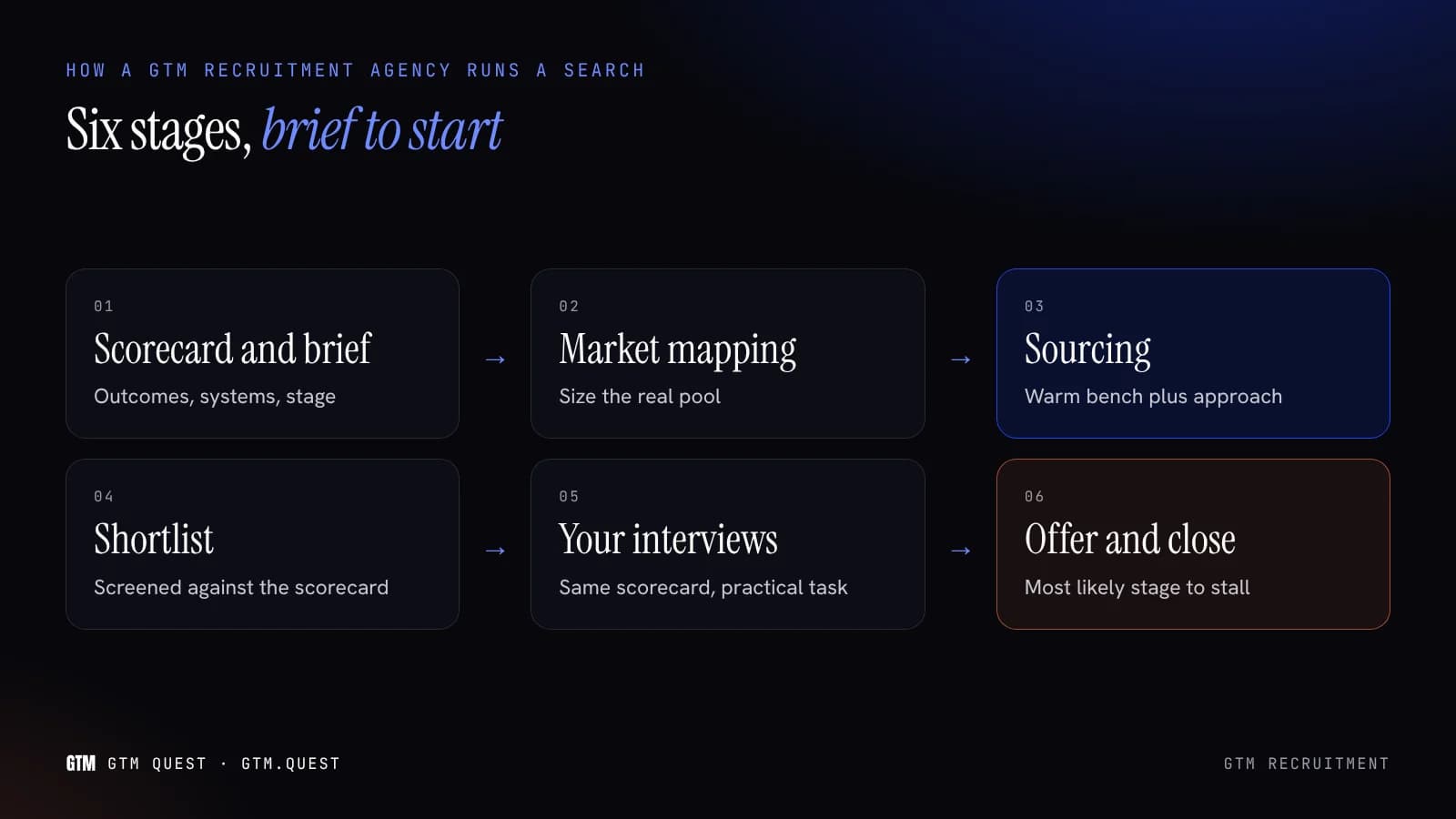
You and the recruiter agree the outcomes, systems and stage experience the role demands, not just a job description.
STAGE 1The recruiter sizes the real pool for this exact profile and says whether it needs contingency or retained treatment.
STAGE 2Agree where the recruiter will source candidates, how it will approach them and what company information it can share.
STAGE 3Technical and commercial screening against the scorecard; a short list you can compare.
STAGE 4Structured interviews against the same scorecard, including a practical task for technical roles.
STAGE 5Pay benchmarked against the market, references, notice period. Agree compensation, references and notice-period expectations before the offer.
STAGE 6Whichever of the GTM recruitment agencies you choose, have the system and scorecard ready before the first call.
For scale: The Josh Bersin Company and AMS reported an average of 44 days to appoint across all industries in Q1 2023.
Specialist, senior and retained searches vary a lot around that.
Benchmark pay before the offer stage with our GTM salary guide.
11/ the stakes
SalesFuel and the Bridge Group are mainly US samples; treat them as direction, not UK prices.
For UK pay, see our GTM salary guide and GTM jobs.
12/ doing it yourself
Many seed and Series A teams hire their first GTM people without a recruiter.
It works when three things are true: a written scorecard, a founder or leader with time to run the process, and a network to start from.
Start with referrals from people you trust, then communities where GTM people gather, then targeted LinkedIn outreach to people doing the job at companies one stage ahead of yours.
Use a practical task (a short Clay build, a mock discovery call, a pipeline review) rather than CV screening alone.
Recruiting marketplace or agency? Compare the work each supplier actually includes: some platforms provide candidate access, while a recruitment agreement can include sourcing, assessment and offer support.
A marketplace suits a team with time and a clear scorecard; an agency suits a hard-to-fill or senior role, or a team with no time.
If the real gap is senior direction rather than headcount, consider a fractional leader first.
A fractional recruitment agency can shortlist people who have held the seat before, working from the same scorecard.
See fractional GTM roles on our sister site, and our comparison of a fractional GTM manager and a GTM agency.
13/ SaaS
For a B2B software hire, include the product and commercial model in the brief.
Buyers research alone, products can often be trialled, and the same accounts hear from every competitor.
So the roles that matter most are the ones that find the right accounts and say something specific to them.
That shifts the profile.
Specify whether an SDR will work from signals, which buyer group an AE will navigate and whether a RevOps lead needs to handle product usage data as well as the CRM.
Brief a recruiter on the motion (founder-led, product-led, sales-led, partner-led), not just the title.
GTM staffing usually means contract or interim cover rather than permanent search: an interim head of sales while you hire, a contract RevOps lead for a CRM migration, a fractional CRO for a funding round.
For senior interim and fractional GTM leaders, see Fractional Quest; for the system work itself, talk to us.
14/ UK rules
UK employment agencies work under specific rules.
GOV.UK sets out that an agency cannot charge a fee to a work-seeker for finding them work, cannot stop someone working elsewhere, and must give workers written terms before looking for work for them.
The employer pays the fee.
Members of the Recruitment & Employment Confederation adhere to a Code of Professional Practice that requires them to disclose all fees, charges and services to clients before accepting an assignment, and to advertise only roles they have documented permission to recruit for.
This is not legal advice.
Read the terms of business before you sign, in particular the fee basis, the rebate period and what counts as an "introduction".
15/ specialists
GTM Quest recruits GTM roles and builds their operating systems; these are additional specialists whose own sites describe go-to-market hiring.
The table retains the 28 September 2026 checks, with Strive and BisonRS scope re-read on 20 October; it is not ranked or paid and we take no referral fees.
For fractional and interim GTM leaders (fractional CRO, CMO, head of sales, founding GTM lead), our sister site Fractional Quest runs the brief and comes back with a shortlist.
For our own work, book a call.
To discuss a recruitment brief, Book a call.
16/ live roles
What GTM teams are hiring for right now, by role. Use it to benchmark titles and salary bands before you brief a recruiter.
Daily feed · source: company career sites via Fantastic Jobs. Check the original advert before applying.
GTM engineer: 12SDR / BDR: 384Account executive: 1064RevOps: 66Demand generation: 34Growth: 67Product marketing: 156Sales leadership: 126GTM leadership: 2
HCM Account Executive
today
Apply ↗Sales Development Representative - Summer 2027 Graduates (Boston)
today
Apply ↗Senior Manager, Oncology Product Marketing
today
Apply ↗Account Executive, Fintech
today
Apply ↗Product Marketing Manager
today
Apply ↗Strategic Account Executive – Enterprise Sales
today
Apply ↗Mid-Market Sales Development Representative
today
Apply ↗Sales Development Representative, Key Accounts
today
Apply ↗SDR - SaaS Mid-Market
today
Apply ↗Account Executive, Velocity Platforms (Hunter)
today
Apply ↗Account Executive, Velocity Platforms (Hunter)
today
Apply ↗Account Executive
today
Apply ↗销售总监 (SDR)
today
Apply ↗Enterprise Account Executive, Thailand
today
Apply ↗Sales Account Executive - Enterprise
today
Apply ↗Associate Account Executive - People Solutions
today
Apply ↗Associate Account Executive - People Solutions
today
Apply ↗Digital Growth Marketing Manager – CRO, SEO, Email & Social Media (AI-Powered)
today
Apply ↗Enterprise Account Executive
today
Apply ↗Enterprise Account Executive
today
Apply ↗Enterprise Account Executive, Consulting
today
Apply ↗Senior Account Executive
today
Apply ↗Account Executive - Mid Market
today
Apply ↗Sr Officer-Account Executive
today
Apply ↗Key Account Executive & VMI - Woolworths
today
Apply ↗17/ terms
GTM Quest editorial guide · Updated 20 October 2026
Choose a GTM recruiter and write a usable hiring brief
Practical guide · 01
Specify what the person must change before specifying a title.
The brief below is an editorial hiring process, not a promise of placement or a fixed search timetable.
Name the bottleneck: missing account data, weak meetings, stalled opportunities or unreliable reporting. Assign one outcome to the role.
Ask for a relevant example and a short work sample. Agree assessment criteria before candidates arrive, using the same criteria for everyone.
List the systems, budget and decisions the hire can control. A revenue target without authority over the motion is an incomplete brief.
Practical guide · 02
Choose the search model separately from the working arrangement: contingency and retained describe payment, while interim and fractional describe how a person works.
Evaluate the written scope.
GOV.UK: employment agencies and businesses ↗
Source checked 10 October 2026
A specialist recruiter can source a clearly defined role. Ask who screens candidates, how duplicate introductions are handled and which terms trigger payment.
For an unfamiliar or confidential leadership role, ask for a market map, assessment method and named search lead before agreeing exclusivity.
Interim or fractional cover can keep decisions moving. Write down the handover to the eventual permanent hire and who owns the work.
Practical guide · 03
Fictional example: a software company has enquiries but nobody can tell which seller owns each account.
Adding another seller would increase the confusion.
Practical guide · 04
Make the commercial boundary reviewable before the search starts.
Ask the supplier to show how its terms apply to the role you are actually filling.
Specify base salary or total compensation, payment triggers, expenses and tax treatment. Record any minimum fee.
Define introduction periods, prior applicants, duplicate submissions and confidentiality. Keep candidate access limited to the hiring team.
Read the replacement or rebate conditions, exclusions and time limits. A verbal assurance is not the agreed remedy.
Practical guide · 05
Assess the work the role will perform.
Tool familiarity can help, but it does not demonstrate judgement, data hygiene or the ability to explain a trade-off.
Ask how an enrichment workflow handles a missing field, a false match and a failed CRM writeback.
For a founding seller, ask what pipeline and process they built themselves; for an enterprise AE, ask how they navigated the buyer group, deal complexity and sales cycle. Use sanitised examples.
Ask how they allocated resources between acquisition and retention, and which evidence changed their original plan.
Practical guide · 06
Keep a separate onboarding process.
The search supplier can introduce the person, but the employer must give them a usable system and clear accountability.
Practical guide · 07
A fast shortlist and a strong hire are different outcomes.
Keep search indicators separate from performance indicators after the person starts.
Track suitable candidates, assessment completion and reasons for declining. Volume alone does not show fit.
Record compensation alignment, notice periods and unresolved questions. Keep expectations consistent through the offer.
Review the agreed outcomes alongside access, support and ramp assumptions. Revenue may lag the work because of the sales cycle.
Practical guide · 08
GTM Quest recruits GTM people and builds their operating systems, and Dan Keegan can be engaged directly as a GTM expert; choose the service from the responsibility you need covered.
Use GTM Quest to define the role, assess candidates and run the search. Name the work, the resources and the evidence of success.
Dan can be engaged as your GTM expert. Agree the problem, responsibilities, decision authority and engagement terms before work starts.
Scope the operating system and hiring work together, with a named owner for the data, workflows and eventual handover.
15 minutes · video or phone
Tell us whether you need us to recruit a GTM hire, want to engage Dan Keegan as your GTM expert, or need the operating system built alongside the person.
Pick a day that suits · live availability
18/ questions
The questions teams ask before they brief a GTM recruiter.
Hiring go-to-market people across sales, marketing, customer success, partnerships, revenue operations and specialist GTM engineering roles.
Sources, screens and places go-to-market roles.
A good one knows the difference between an SDR, an AE, a GTM engineer and a RevOps lead, and screens for people who have done the work.
A GTM recruiter specialises in go-to-market hiring across sales, marketing, customer success, partnerships and the operations behind them.
It depends on the hire.
We list firms by what their own sites say they do (technical, sales volume, SaaS scale-ups, executive search) in specialists worth knowing.
We do not rank them.
In the UK, contingency fees usually run 15% to 20% of first-year salary, up to 30% for hard-to-fill roles; retained search typically 25% to 35% of base salary, paid in three stages.
See the fee table.
Contingency: paid only on placement, often non-exclusive.
Retained: an exclusive search paid in stages from the start, used for senior and confidential roles.
See the comparison.
We do not rank them.
True runs a dedicated go-to-market practice and Talentfoot describes itself as an executive search firm for sales and marketing leaders; UK firms such as Teem and Wilson Grey handle senior GTM hiring.
See the specialists.
Look for firms that name GTM engineering on their own site, and ask for recent GTM engineer placements and how they assess Clay skills.
Compare your time to source and assess candidates with the specialist coverage and responsibilities an agency offers; use the same role scorecard either way.
A written scorecard, referrals first, then communities and targeted LinkedIn outreach, and a practical task in the interview.
A marketplace suits a team with time and a clear scorecard; an agency suits hard-to-fill or senior roles, or a team without time to source.
The Josh Bersin Company and AMS reported a global average of 44 days to appoint in Q1 2023, across all industries.
Senior and specialist GTM searches often take longer.
SalesFuel puts the average cost of a bad B2B sales hire at $177,171, including lost forecasts, weaker customer relationships and lost productivity.
No. GOV.UK says an agency cannot charge a fee to a work-seeker for finding them work; the employer pays.
Yes.
Dan can be engaged directly as a GTM expert; book a call to agree the problem, responsibilities and engagement terms.
Yes.
We recruit GTM roles for employers through our GTM recruitment agency, and we build the go-to-market system those hires run.

Book 15 minutes · London · UK and Europe
Discuss recruitment through GTM Quest, engaging Dan Keegan as your GTM expert, or building the system alongside the person.
20/ sources
Each figure links to its source. Original source checks: 28 September 2026. The practical guide was updated on 20 October 2026.