
Fractional growth · head of growth · guide
Fractional growth team how to assemble one, what it costs and how to run it
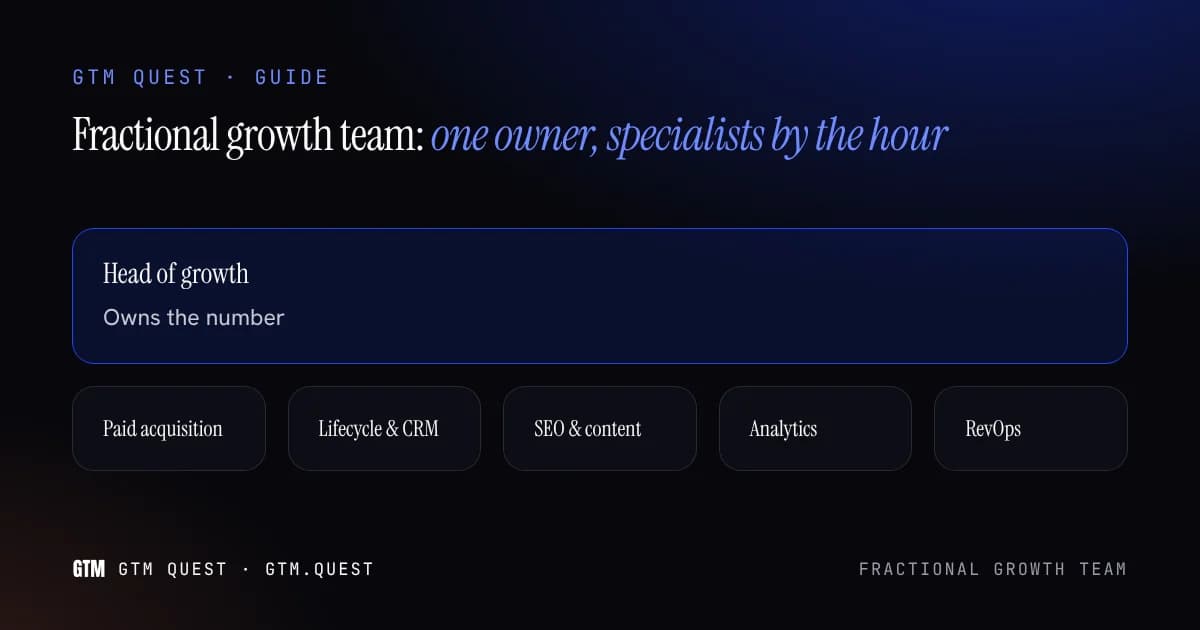
A fractional growth team is a growth function built from part-time parts: one senior person who owns the number and the experiment backlog, plus specialists in paid acquisition, lifecycle, SEO and content, analytics and RevOps who plug in for the hours each channel needs.
GTM Quest is a London GTM agency that builds B2B pipeline systems, and we often work inside teams like this.
This guide covers the roles, published costs, how to run experiments with ICE and RICE, the metrics, the weekly cadence, when a growth agency is the better buy and when to hire full time.
Reviewed by Dan Keegan, GTM Quest · October 16, 2026 · 17 sources linked below
How a fractional growth team runsone owner, a backlog and a weekly rhythm
- 01Set the numberWEEK 1 TO 2NORTH STAR · BASELINE
- 02Fill the backlogWEEK 2 TO 4IDEAS · ICE OR RICE
- 03Run the loopEVERY WEEKTEST · READ · DECIDE
- 04Scale or hireEVERY QUARTERDOUBLE DOWN · STAFF UP
Fractional chief growth officer, average hourly rate (GoFractional)$174
01/ the definition
What is a fractional growth team? and how it differs from an agency or a fractional CMO
A fractional growth team is a growth function you rent by the role.
One part-time lead (a fractional head of growth or a senior growth marketer) owns a single growth number and decides what gets tested.
Part-time specialists do the channel work.
Every person is on a monthly contract, and you add or drop seats as the evidence comes in.
The difference from hiring is commitment, not quality.
You get people who have done the job before, for the hours the work needs.
The difference from a growth agency is ownership: the people work inside your tools, your CRM and your Slack, and you can keep any of them when the engagement ends.
The phrase growth team as a service describes the packaged version of the same idea, where one firm supplies the lead and the specialists.
London's Growth Division, for example, says most of its teams cost £5,000 to £10,000 a month plus VAT: a growth strategist at £2,000 to £3,000 a month plus channel experts from about £1,000 a month each.
Fractional head of growth vs fractional growth marketer
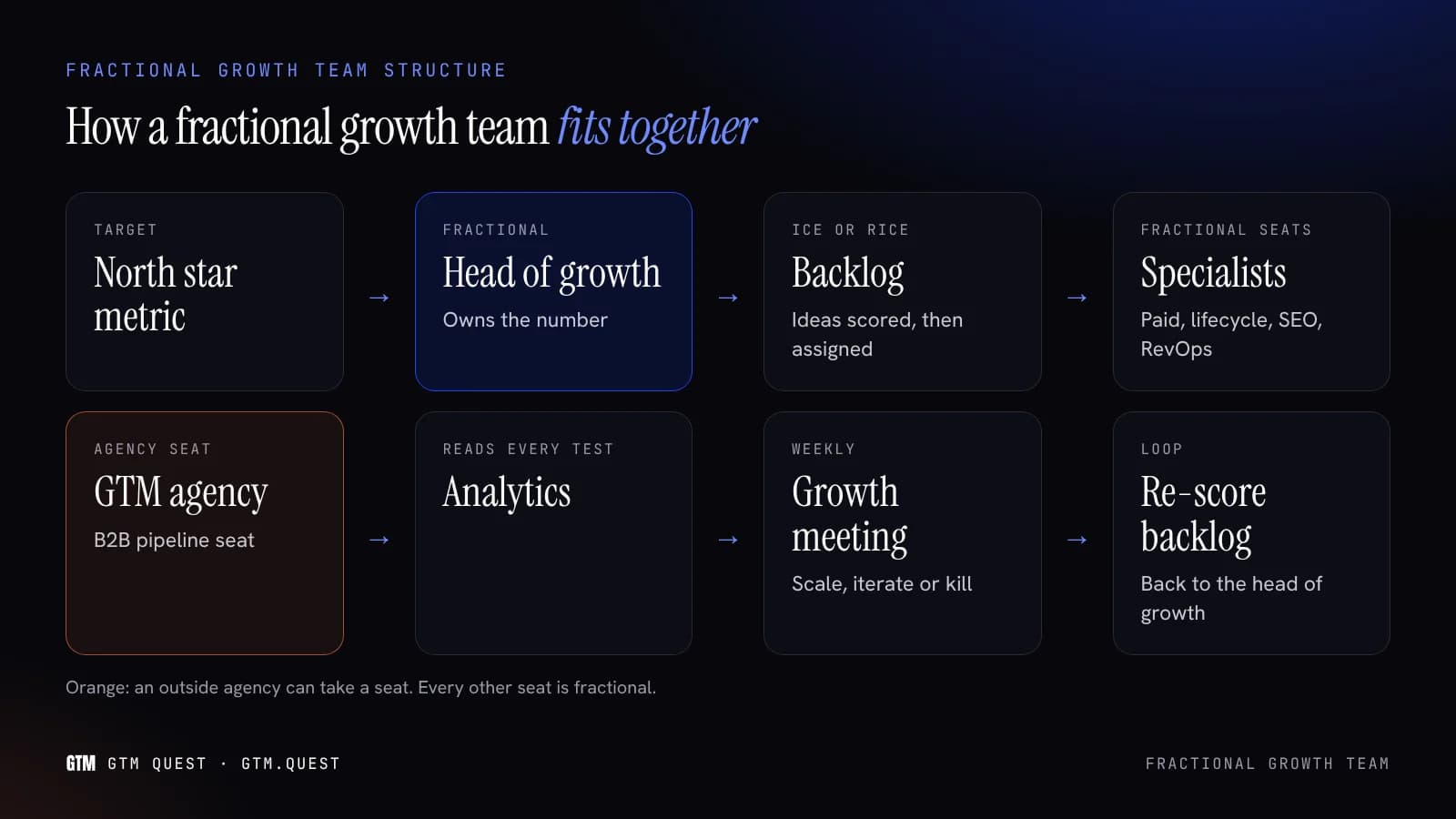
A fractional head of growth sets the growth strategy, owns the experiment backlog, manages specialists or agencies and reports to the CEO.
A fractional growth marketer is usually a senior hands-on operator who runs one or two channels and their tests.
MarketerHire says a fractional head of growth typically works 10 to 20 hours a week; start there if nobody owns the number, and with a growth marketer if someone does.
Fractional growth team vs fractional CMO
A fractional CMO owns the whole marketing function: positioning, brand, budget, team and board reporting.
A fractional growth team owns a narrower thing, a measurable growth number and the experiments that move it.
MarketerHire draws the same line: a head of growth optimizes for metrics such as acquisition cost and conversion, while a CMO leads the full marketing organization.
Where the sales side sits
This page covers marketing-led growth: acquisition, activation, retention and the data under them.
The sales half of a fractional go-to-market team (a fractional VP of sales, SDR capacity and sales operations) is on our fractional sales team page.
Many companies need both, joined by one pipeline definition.
02/ the roles
The roles in a fractional growth team one owner and five specialist seats
Few teams fill every seat at once.
Start with the owner and the one or two specialists your best channel needs, then add seats when a test earns them.
Owner
Fractional head of growth or growth marketer
Owns one growth number, keeps the backlog, scores and picks experiments, runs the weekly growth meeting and reports results.
Without this seat, specialists optimize their own channels and nobody chooses between them.
- ✓ North star metric and targets
- ✓ Experiment backlog and scoring
- ✓ Weekly growth meeting
- ✓ Budget across channels
Find one on Fractional Quest.
Specialist
Paid acquisition
Runs paid search, paid social and LinkedIn ads: account structure, creative tests, bidding and budget pacing.
In B2B, judge it on qualified pipeline, not cost per click.
- ✓ Google, Meta and LinkedIn ads
- ✓ Creative and audience tests
- ✓ Spend pacing against pipeline
Specialist
Lifecycle and CRM marketing
Owns what happens after the first conversion: onboarding emails, trial nurture, activation prompts, expansion and win-back.
Often the cheapest growth, because the audience is already yours.
- ✓ Onboarding and nurture flows
- ✓ Activation and expansion
- ✓ Segmentation in the CRM
Specialist
SEO and content
Builds demand you do not pay for per click: search-led pages, comparison and pricing content, and the technical fixes behind them.
Slow to show results, so give it a longer test window than paid.
- ✓ Keyword and page plan
- ✓ Content production
- ✓ Technical SEO
Specialist
Analytics
Makes the numbers trustworthy: event tracking, attribution, experiment readouts and the dashboard the team meets around.
Kohavi warns that "getting numbers is easy; getting numbers you can trust is hard".
- ✓ Tracking plan and events
- ✓ Experiment readouts
- ✓ One shared dashboard
Specialist
RevOps
Connects marketing data to pipeline and revenue: lifecycle stages, lead routing, CRM hygiene and the handoff to sales.
For a part-time RevOps lead, see fractional RevOps on Fractional Quest; for firms, see revenue operations agencies.
- ✓ Lifecycle stages and routing
- ✓ CRM and tool integrations
- ✓ Pipeline reporting
Demand generation is often a separate seat in B2B: campaigns, webinars, content syndication and paid programs aimed at in-market accounts.
If that is your main need, compare demand generation agencies with a fractional demand generation lead.
The tools these roles share are covered in our GTM tech stack guide.
03/ the decision
Which shape of growth team fits you? pick your situation
Fractional people, a growth agency and a full-time hire solve different problems.
Pick the sentence closest to where you are.
What best describes growth at your company today?
Fractional head of growth
Start with a fractional owner
Hire the person who sets the number and the backlog before you hire channel help.
Specialists without an owner produce activity, not learning.
- ✓ Part time, scoped to the backlog
- ✓ Owns the backlog and the weekly meeting
- ✓ Adds specialists as tests earn them
Shortlist one on Fractional Quest.
Fractional specialists
Add specialists by the seat
Your lead knows what to test.
Add a paid, lifecycle or SEO specialist for the channels in the backlog, and an analytics or RevOps seat if readouts are slow or disputed.
- ✓ One specialist per live channel
- ✓ Analytics before a third channel
- ✓ Monthly terms, reviewed each quarter
Growth agency
Buy a growth agency or a growth team as a service
An agency supplies the lead and the specialists under one contract and manages them for you.
You trade some ownership and continuity for less management time.
- ✓ One invoice, one point of contact
- ✓ Bench cover when someone leaves
- ✓ Ask who keeps the accounts and data
Compare firms on our growth marketing agencies page.
GTM agency
Use a GTM agency for the pipeline system
If your growth number is qualified meetings and pipeline, the work is ICP lists, signal-led outbound, LinkedIn content and ads, and CRM plumbing.
A GTM agency builds and runs that system.
- ✓ ICP and account lists
- ✓ Signal-led outbound on Clay
- ✓ CRM and RevOps
This is what GTM Quest does as a GTM agency. See what a go-to-market agency is.
Full-time hire
Hire a full-time head of growth
When the backlog, the team and the budget need daily attention, part-time leadership becomes the bottleneck.
Use the fractional lead to write the role and hand over.
- ✓ Daily management of several people
- ✓ A proven channel to scale
- ✓ Budget that needs constant tuning
Not sure which applies?
A GTM consultant can answer the question in a short, fixed-scope engagement, or try the GTM scorecard for a quick read.
04/ cost
How much does a fractional growth team cost? published figures, labeled by type
There is no independent survey of fractional growth team prices.
The Type column separates salary data and rate benchmarks from prices firms publish about themselves or their market.
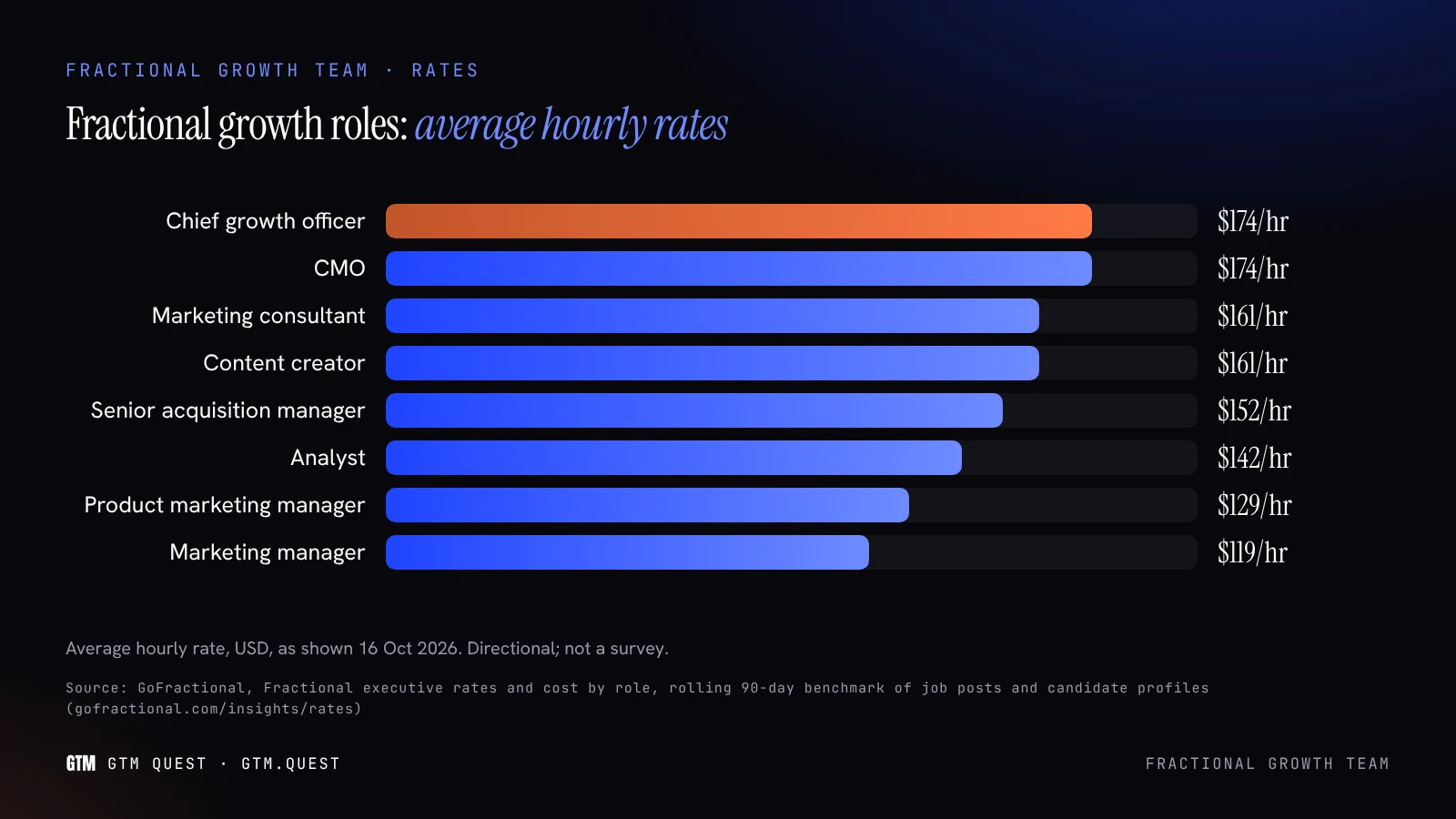
GoFractional builds monthly figures as hourly rate times typical weekly hours times four weeks, and says the 13-hour week is a cross-role typical scope because chief growth officer data is too thin for a role-specific figure.
Its CGO benchmark rests on 9 job posts and 628 candidate profiles from the last 90 days.
Treat it as directional.
For example (a lean US team): a fractional head of growth at MarketerHire's $8,000 to $12,000 band, plus one acquisition specialist at GoFractional's $6,700 to $9,300 monthly range, comes to $14,700 to $21,300 a month before ad spend and tools.
That is $176,400 to $255,600 a year for two senior people, part time.
05/ experiments
How a fractional growth team runs experiments from idea to decision in five steps
The backlog is the team's real product.
A fractional lead with limited hours needs a process that turns many ideas into a few good tests every week.
Agree the one metric
Pick the number every test is judged against: qualified pipeline, activated accounts or paid conversions.
Kohavi calls this the overall evaluation criterion and says getting agreement on it is "a huge step forward".
- ✓ One north star metric
- ✓ Two or three input metrics under it
- ✓ A baseline before the first test
Collect ideas in one backlog
Everyone adds ideas to one list, each written as a hypothesis: if we do X for audience Y, metric Z moves, because of evidence W.
Ideas without a metric do not enter the list.
- ✓ One shared backlog
- ✓ Hypothesis format
- ✓ Tagged by funnel stage
Score with ICE or RICE
Rank ideas so the meeting debates the top ten, not the whole list.
ICE is faster; RICE adds reach.
Both are relative: the score orders your backlog, it does not predict the result.
- ✓ ICE: impact, confidence, ease
- ✓ RICE: reach × impact × confidence ÷ effort
- ✓ Re-score after every test
Pick a few and launch
GrowthHackers' own team says it greenlights 3 to 5 ideas a week from up to ten nominations.
A fractional team with fewer hours should run fewer, larger tests, each with a stop date and a success threshold written down first.
- ✓ Owner, start and stop date
- ✓ Success threshold set in advance
- ✓ Smallest test that answers the question
Read, decide, record
At the stop date, the analytics seat reads the result and the team decides: scale, iterate or kill.
Every result, including the failures, goes into a log so the next scores are better informed.
- ✓ Scale, iterate or kill
- ✓ A one-paragraph write-up
- ✓ Confidence scores updated
Expect most tests to lose.
Kohavi's data from Microsoft: a third of ideas positive, a third flat, a third negative.
At Bing, which was already heavily optimized, he put the failure rate at about 80% to 90%.
A team that wins every test is not testing anything risky.
06/ frameworks
ICE vs RICE scoring two named frameworks, and when to use each
Both turn a debate about opinions into a ranked list.
Pick one and use it consistently; switching frameworks every quarter is worse than either.
For example (ICE): a pricing-page headline test scored impact 6, confidence 7, ease 9 averages 7.3.
A new LinkedIn ads channel scored impact 8, confidence 4, ease 3 averages 5.0.
The headline test runs first; the channel idea needs evidence (a small budget test or customer interviews) to raise its confidence before it earns a slot.
Ellis says he stops talking about scores once the team is in the growth meeting: ICE shortlists ideas, then the team judges the shortlist on its merits.
Intercom says the same of RICE: it is not "a hard and fast rule".
07/ B2B reality
Growth experiments with B2B traffic what to test when you cannot A/B test everything
Classic A/B testing needs volume.
Kohavi's example: a commerce site that wants to detect a 2% change in revenue needs about 100,000 users per variant.
Most B2B sites see a small fraction of that on the pages that matter, so a fractional B2B growth team has to test differently.
Test bigger changes. A new offer, a new channel or a new audience produces differences large enough to see in weeks.
Button colors do not.
Test on the fastest signal. Reply rates, meeting rates and demo-to-opportunity conversion move faster than closed revenue.
Agree with sales which leading indicator counts, then confirm the winners against pipeline later.
Use time-boxed channel tests. Give a new channel a fixed budget, a fixed window and a success threshold set in advance.
Stop or scale at the end; do not let a test drift into a permanent line item.
Use qualitative evidence for confidence. Customer interviews and win-loss calls are cheap and raise or lower confidence scores before you spend.
Ellis's own product/market fit survey is one such tool: he found that startups with strong traction usually had more than 40% of users say they would be "very disappointed" without the product.
08/ metrics
The metrics a fractional growth team reports one north star, inputs under it, health checks beside it
A fractional team has limited hours, so it reports few numbers, the same way every week.
Dave McClure's pirate metrics (acquisition, activation, retention, referral, revenue) are a common skeleton for the input layer.
CAC payback is the months of gross margin from a new customer needed to recover what it cost to acquire them.
The right target depends on your margins and cash; pick one with finance and hold it steady, rather than borrowing a benchmark.
If marketing pipeline and sales pipeline are counted differently, fix that first.
It is usually a RevOps job; our revenue operations agencies page lists firms that do it.
09/ cadence
The operating cadence what happens each week, month and quarter
Part-time teams fail when they have no rhythm, because nobody is in the room every day to notice drift.
Fix the rhythm in the contract.
Async updates
The signal
Specialists post what launched, what broke and what needs a decision in one shared channel.
The play
The head of growth answers blockers within a working day.
Owner: All seats
Growth meeting
The signal
Last week's results, the north star trend and the top of the scored backlog.
The play
Decide scale, iterate or kill for each finished test; pick the next tests.
Owner: Head of growth
Channel review
The signal
Spend, pipeline and CAC by channel against targets.
The play
Move budget toward what works; add or drop a specialist seat.
Owner: Head of growth with CEO
Strategy and scope reset
The signal
Progress on the north star, the experiment log and team cost.
The play
Reset targets, renew or change contracts, decide whether to hire full time.
Owner: CEO and head of growth
10/ compare
Fractional growth team vs growth agency vs full-time hire ownership, cost and speed
Pick a comparison.
Each tab sets the fractional model against the option most people weigh it against.
→ Pick fractional people when you want to own the team and the learning. Pick an agency when management time is your scarcest resource. Our growth marketing agencies page compares firms.
→ Fractional wins while you are still searching for repeatable channels. Full time wins once a channel works and the job becomes running it every day.
→ They combine well: the fractional head of growth owns the number, and a GTM agency or an ABM agency runs the pipeline channels as one of the specialist seats.
11/ next stage
When to replace fractional with full time six signals
- 01
A channel works and needs daily running
The search is over for that channel. Running and scaling it every day is a job, not an experiment.
PROOF - 02
The owner is the bottleneck
Tests wait for the head of growth's days. Readouts and decisions back up between visits.
CAPACITY - 03
Specialist hours add up to a salary
When one specialist bills most of a working week every month, compare their annual cost with a full-time salary plus benefits.
COST - 04
You need people managed every day
Junior marketers need coaching, reviews and hiring that a part-time lead cannot cover.
TEAM - 05
Product/market fit is clear
Ellis [advised against bringing in VPs of marketing and sales](https://www.startup-marketing.com/2009/07/) before fit. Once fit is clear, a full-time growth leader has something to scale.
STAGE - 06
The board wants a named leader
Some investors want a full-time growth or marketing leader on the org chart before the next round.
GOVERNANCE
Use the fractional lead to write the role, interview candidates and hand over the backlog and the experiment log.
That handover is worth more than any single test.
For full-time pay benchmarks, see the GTM salary guide.
12/ due diligence
Hiring a fractional head of growth questions to ask and red flags
Ask
Questions for every candidate
Good answers include numbers, dates and a failure.
- ✓ Which metric would you make our north star, and why?
- ✓ Walk me through a channel you scaled. What did you test first?
- ✓ Tell me about a test you killed. How did you decide?
- ✓ How do you score the backlog: ICE, RICE or something else?
- ✓ Which specialist would you add first, and what would they cost?
- ✓ How many clients do you have, and which days would be ours?
Avoid
Red flags
Any one of these is a reason to slow down.
- ✓ A channel plan before they have seen your data
- ✓ Every past test was a win
- ✓ Reports clicks and impressions, not pipeline or revenue
- ✓ Wants ad accounts or data in their own name
- ✓ No written success threshold before a test starts
- ✓ Pushes their own agency or tools without saying so
Fractional Quest, our sister site, is a marketplace for fractional executives and lists fractional head of growth and fractional RevOps roles and candidates.
13/ our service
How GTM Quest fits into a fractional growth team the B2B pipeline seat
We are not a fractional head of growth and we do not run paid search or SEO programs.
We are the specialist seat for B2B pipeline: ICP and positioning, LinkedIn content and ads, signal-led outbound built on Clay, and the CRM and RevOps that measure it.
In a fractional growth team, we take tests from the shared backlog (a new segment, a new signal, a new LinkedIn offer), run them, and report results weekly in your CRM against the team's north star.
Everything lives in accounts you own.
If you are deciding which seats to fill first, the call below is a good place to start.
For the sales half of the picture, read the fractional sales team guide.
15 minutes · video or phone
Book 15 minutes before you assemble a growth team
Tell us your stage, your pipeline target and who does growth today. We will tell you which roles to fill first, whether an agency or fractional people fit better, and what to measure, whether or not you work with us.
- 0115 minutes, video or phone
- 02Which fractional roles to fill first
- 03A written next step after the call
- 04We run inside growth teams every week
Pick a day that suits · live availability
14/ questions
Fractional growth team FAQ
What people search for about fractional heads of growth, fractional growth marketers and growth teams as a service, answered with sources.
A growth function built from part-time people: a fractional head of growth or growth marketer who owns the number and the backlog, plus specialists for paid, lifecycle, SEO, analytics and RevOps.
See the definition.
Sets the growth strategy, owns one growth metric and the experiment backlog, runs the weekly growth meeting and manages specialists or agencies.
MarketerHire says the role typically takes 10 to 20 hours a week.
MarketerHire says $5,000 to $15,000 a month.
GoFractional's benchmark for a fractional chief growth officer averages $174 an hour, or $6,500 to $10,400 a month at about 13 hours a week.
See the cost table.
A senior, hands-on growth operator who runs one or two channels and their experiments part time, usually under someone who owns the overall number.
A firm supplies the growth lead and the channel specialists under one contract.
Growth Division, for example, quotes £5,000 to £10,000 a month plus VAT for most teams.
See which shape fits.
A part-time demand generation lead who runs B2B campaigns, webinars, paid programs and content aimed at in-market accounts.
It is often one seat in a fractional growth team; compare demand generation agencies.
A part-time revenue operations lead who owns lifecycle stages, lead routing, CRM hygiene and pipeline reporting.
Find one on Fractional Quest; the sales-side role is covered on our fractional sales team page.
Part-time go-to-market leadership across marketing, sales and RevOps.
Its marketing half is the growth team on this page; its sales half is on our fractional sales team page, and its leadership is often a fractional CMO.
ICE (impact, confidence, ease), credited to Sean Ellis, is faster for many small growth tests.
RICE, from Intercom, adds reach and suits bigger projects.
See ICE vs RICE.
As many as you can read reliably.
GrowthHackers' own team greenlights 3 to 5 a week; a part-time team with low B2B traffic should run fewer, larger tests.
See B2B experiments.
Fractional people if you want to own the team, accounts and learning; an agency if you want one contract and someone else to manage the people.
See the comparison and our growth marketing agencies page.
When a channel works and needs daily running, the fractional lead has become the bottleneck, or specialist hours add up to a salary.
See six signals.

Book 15 minutes · London · US and UK clients
Building growth from fractional parts? We’ll tell you which seat to fill first.
A 15-minute call, a written next step, and if it fits, the B2B pipeline system your growth team will run.
16/ sources
Every source on this page
Each figure above links to one of these. All were opened and checked on October 16, 2026.
- GoFractional, Fractional Chief Growth Officer cost and rates (updated 16 Oct 2026)gofractional.com
- MarketerHire, What is a fractional head of growth? (June 2026)marketerhire.com
- Ronny Kohavi, Microsoft ExP, Trustworthy A/B tests: pitfalls in online controlled experiments (May 2017)exp-platform.com
- Payscale, Growth Marketing Manager salary, US (updated June 2026)payscale.com
- Growth Division, home page and FAQ (pricing)growth-division.com
- Ronny Kohavi, Microsoft ExP, Lessons from running thousands of A/B tests (MIT CODE, Oct 2014)exp-platform.com
- Fractional Quest, Fractional head of growth jobs and hiringfractional.quest
- Fractional Quest, Fractional RevOps jobs and hiringfractional.quest
- GoFractional, Fractional executive rates and cost by role (rolling 90 days, updated 16 Oct 2026)gofractional.com
- GTM Guys, Growth Team as a Servicegtm-guys.com
- US Bureau of Labor Statistics, Occupational Outlook Handbook: marketing managersbls.gov
- GrowthHackers (Anuj Adhiya), The practical advantage of the ICE score (Nov 2017)medium.com
- Breakout Growth podcast, Sean Ellis and Ethan Garr on ICE scoring (Mar 2022)breakoutgrowth.net
- Intercom (Sean McBride), RICE: simple prioritization for product managers (Jan 2018)intercom.com
- Sean Ellis, Startup Marketing Blog, July 2009 (product/market fit and the 40% test)startup-marketing.com
- Dave McClure, Startup metrics for pirates (slides)slideshare.net
- Fractional Questfractional.quest